[]
- Published: 18 December 2000
- ISBN: 9780141906324
- Imprint: Penguin eBooks
- Format: EBook
- Pages: 208
Categories:
Medea And Other Plays
Formats & editions
Buy from…
Penguin Classics relaunch.
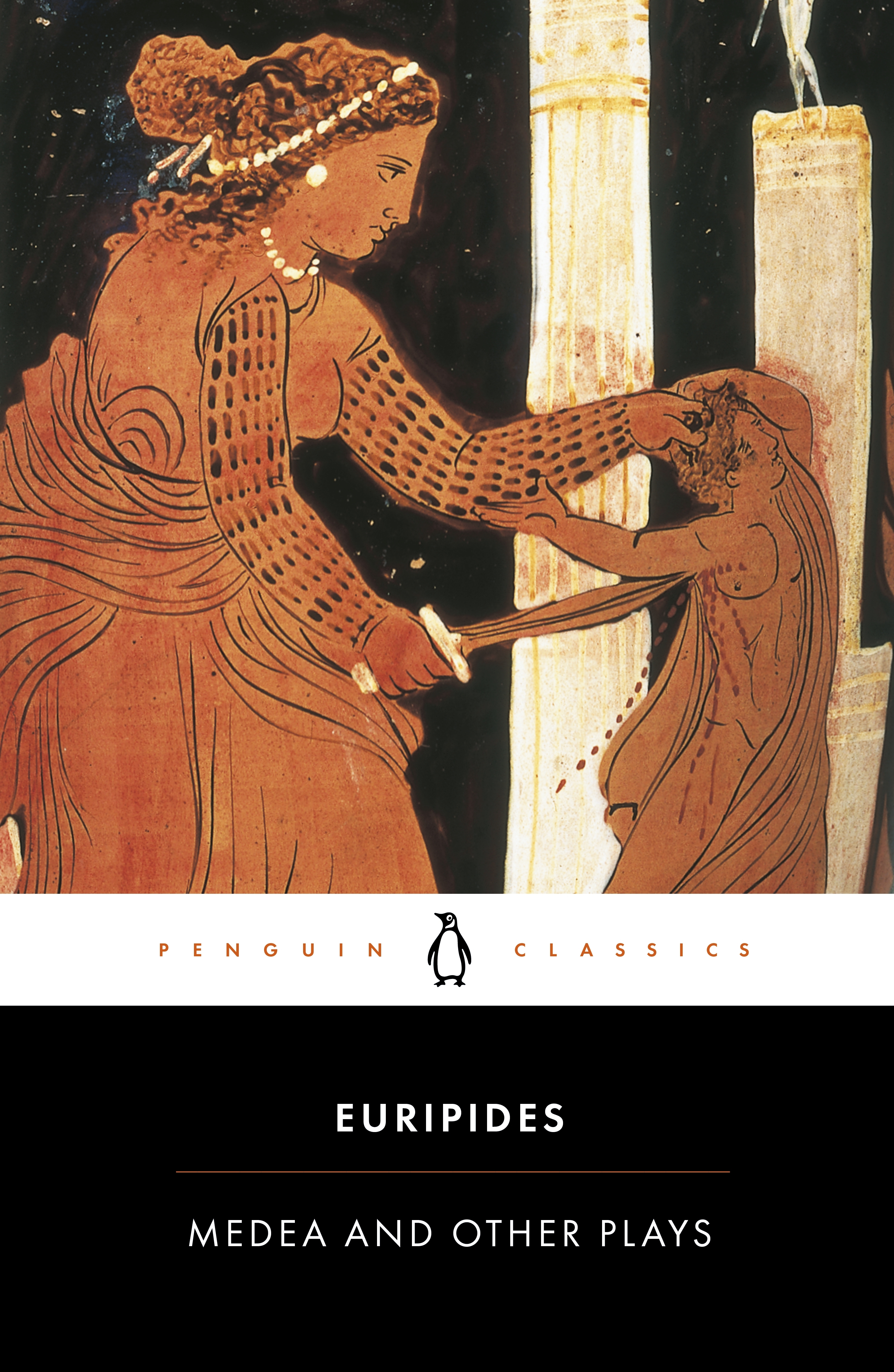
Medea, in which a spurned woman takes revenge upon her lover by killing her children, is one of the most shocking and horrific of all the Greek tragedies. Dominating the play is Medea herself, a towering and powerful figure who demonstrates Euripides' unusual willingness to give voice to a woman's case. Alcestis, a tragicomedy, is based on a magical myth in which Death is overcome, and The Children of Heracles examines the conflict between might and right, while Hippolytus deals with self-destructive integrity and moral dilemmas. These plays show Euripides transforming the awesome figures of Greek mythology into recognizable, fallible human beings.
- Published: 18 December 2000
- ISBN: 9780141906324
- Imprint: Penguin eBooks
- Format: EBook
- Pages: 208
Categories:
Other books in the series
The Complete Fables
Aesop
Emma
Jane Austen
Pride and Prejudice
Jane Austen
Mansfield Park
Jane Austen
Northanger Abbey
Jane Austen
Persuasion
Jane Austen
Sense and Sensibility
Jane Austen
A Dead Man's Memoir (A Theatrical Novel)
Mikhail Bulgakov
A Dog's Heart
Mikhail Bulgakov
The Man Who Was Thursday
G. K. Chesterton
The Black Tulip
Alexandre Dumas
The Lady of the Camellias
Alexandre Dumas fils
The Man in the Iron Mask
Alexandre Dumas
The Three Musketeers
Alexandre Dumas
Faust, Part I
Goethe
Faust, Part II
Goethe
Selected Poetry
Goethe Johann Wolfgang Von
The Nibelungenlied
Hatto A T
The Complete Odes and Epodes
Horace
The Garden Party and Other Stories
Katherine Mansfield
The Aeneid
Virgil
Species of Spaces and Other Pieces
Georges Perec
The Age of Alexander
Plutarch
Fall Of The Roman Republic
Plutarch
The Makers of Rome
Plutarch
On Sparta
Plutarch
The Rise And Fall of Athens
Plutarch
The Rise of Rome
Plutarch
Rome in Crisis
Plutarch
Man and Superman
George Bernard Shaw
Saint Joan
George Bernard Shaw
Botchan
Natsume Soseki
Kusamakura
Natsume Soseki
The Charterhouse of Parma
Stendhal
Love
Stendhal
The Red and the Black
Stendhal
Agricola and Germania
Tacitus
Annals
Tacitus
The Annals of Imperial Rome
Tacitus
Selected Poems
Rabindranath Tagore
Military Dispatches
The Duke Of Wellington
Around the World in Eighty Days
Jules Verne
Journey to the Centre of the Earth
Jules Verne
Twenty Thousand Leagues Under the Sea
Jules Verne
Treatise On Toleration
Voltaire
About the authors
Euripides is thought to have lived between 485 and 406 BC. He is considered to be one of the three great dramatists of Ancient Greece, alongside Aeschylus and Sophocles. He is particularly admired by modern audiences and readers for his characterization and astute and balanced depiction of human behaviour. Medea is his most famous work.
Date: 2013-08-06
Euripides is thought to have lived between 485 and 406 BC. He is considered to be one of the three great dramatists of Ancient Greece, alongside Aeschylus and Sophocles. He is particularly admired by modern audiences and readers for his characterization and astute and balanced depiction of human behaviour. Medea is his most famous work.
Robin Robertson is from the north-east coast of Scotland. He is the author of three collections of poetry: A Painted Field (1997), winner of the 1997 Forward Poetry Prize (Best First Collection), the Aldeburgh Poetry Festival Prize and the Saltire Society Scottish First Book of the Year Award; Slow Air (2002); and Swithering (2006). He is also the editor of Mortification: Writers' Stories of their Public Shame (2003). In 2004, he was named by the Poetry Book Society as one of the 'Next Generation' poets, and received the E. M. Forster Award from the American Academy of Arts and Letters. Robin Robertson's third poetry collection, Swithering (2006), was shortlisted for the 2005 T. S. Eliot Prize and won the 2006 Forward Poetry Prize (Best Poetry Collection of the Year). In 2013 Robin Robertson was awarded the Petrarca-Preis. He lives and works in London.
Euripides, the youngest of the three great Athenian playwrights, was born around 485 BC of a family of good standing. He first competed in the dramatic festivals in 455 BC, coming only third; his record of success in the tragic competitions is lower than that of either Aeschylus or Sophocles. There is a tradition that he was unpopular, even a recluse; we are told that he composed poetry in a cave by the sea, near Salamis. What is clear from contemporary evidence, however, is that audiences were fascinated by his innovative and often disturbing dramas. His work was controversial already in his lifetime, and he himself was regarded as a 'clever' poet, associated with philosophers and other intellectuals.
Towards the end of his life he went to live at the court of Archelaus, king of Macedon. It was during his time there that he wrote what many consider his greates work, the Bacchae. When news of his death reached Athens in early 406 BC, Sophocles appeared publicly in mourning for him. Euripides is thought to have written about ninety-two plays, of which seventeen tragedies and one satyr-play known to be his survive; the other play which is attributed to him, the Rhesus, may in fact be by a later hand.