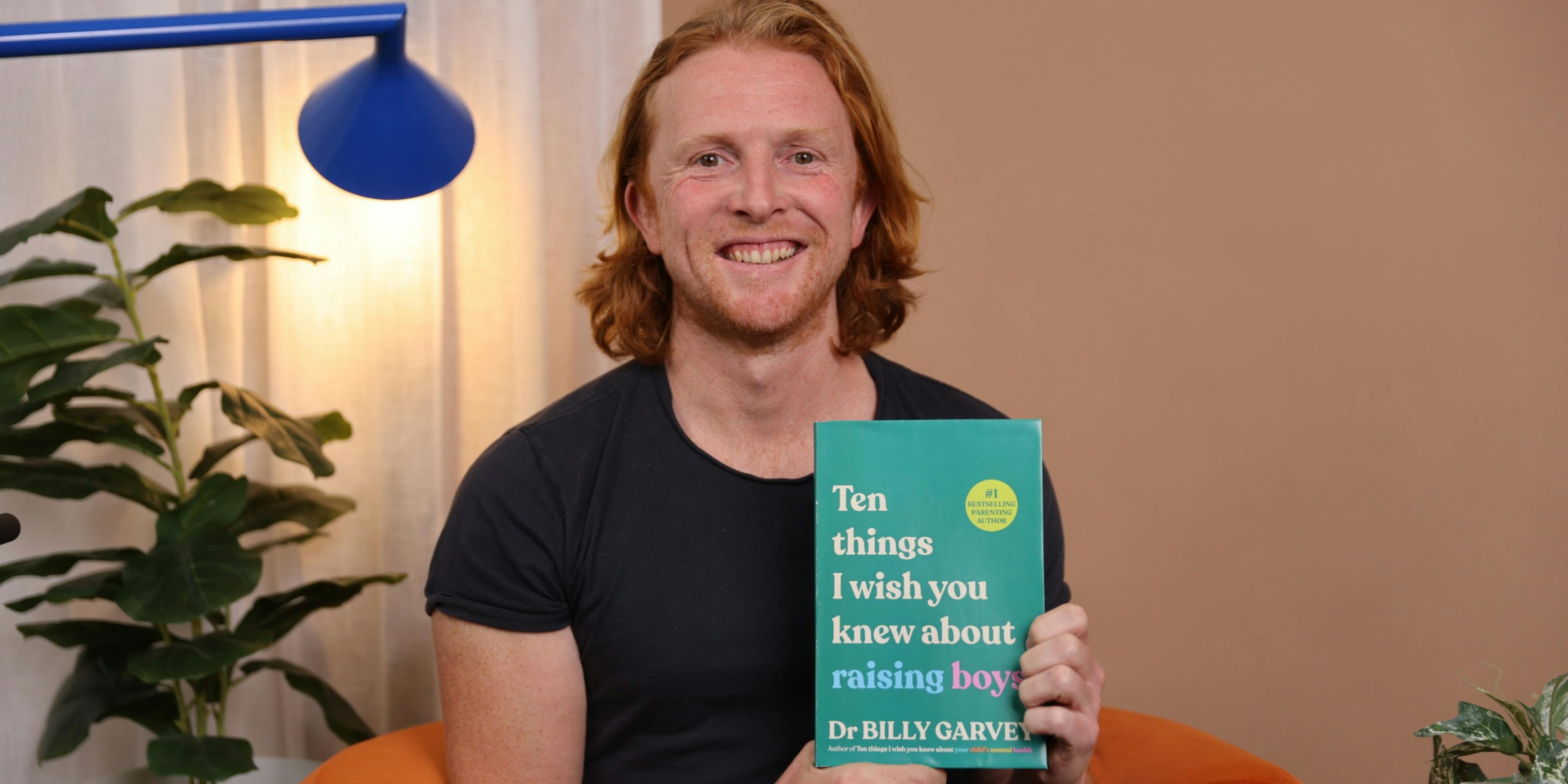
We asked developmental paediatrician Dr Billy Garvey about his new book, Ten Things I Wish You Knew About Raising Boys, and how parents can help boys build the emotional and social skills they need to thrive.

From toxic masculinity to changing expectations of what it means to be a man, boys are growing up with increasingly complex messages about who they should be. Many parents are asking the same question: how do we raise boys to become happy, healthy and connected men?
Here, Dr Billy Garvey shares his practical advice.
1. What made you want to write Ten Things I Wish You Knew About Raising Boys?
A big part of my work is taking what we know from child development and mental health research and making it useful in everyday life.
Over many years working with children and families, I’ve seen the same patterns come up again and again with boys. They experience all the same difficult emotions, anger, fear, rejection, jealousy, insecurity, but often they haven’t been given the skills or permission to understand and communicate them. I wanted this book to look at what we can do differently from the very beginning, and how parents and carers can help boys build those skills as they grow.
2. One of the big ideas in Ten Things I Wish You Knew About Raising Boys is challenging the idea that boys should be ‘tough’ and hide their emotions. Why is that so important?
It’s a really dangerous idea. It’s 60 years of research that’s shown us that across cultures, the idea that boys and men shouldn’t express emotions increases mental illness in men. They are going to have anger and fear and anxiety and rejection and jealousy and insecurity. It’s that they’re expressing them in really dangerous and violent ways, and they feel that is a normal part of manhood. And it starts way earlier than the teenage years, my two-year-old came home and said, “I want to be a boy.” When we asked why, she said, “Because boys don’t cry.”
3. In the book, you talk about how we respond when children are overwhelmed or having a meltdown. What should parents understand in those moments?
When a child is overwhelmed, aggressive or having a meltdown, we can be very quick to focus on stopping the behaviour. But if we only say, “Stop that,” or “Go away until you calm down,” we can miss what’s actually going on underneath.
I do sometimes take my kids out of an overwhelming environment, but I go with them. We calm down together, reconnect, work out what they need, and then think about how they can go back and succeed. The important thing is that it isn’t punishment. It’s more: this environment is too much right now, so we’re going to huddle and then go back in together.
4. There’s a memorable story in the book about buying your son a doll. What did that experience teach you about raising boys?
That was reactive because he was hurting his baby sister. He was struggling and insecure with the way the world had changed for him. He wasn’t two yet, and he’d gone from being the baby that was cared for to watching someone else. I needed to give him the skillset of, instead of stopping him doing something, I wanted to teach him something to do instead. So it was never about “stop hitting, stop hurting”. It was, “This is how to be with your baby sister.”
5. Communication is one of the ten areas you dive into, and it can play an important role in children’s mental health. Why do boys often find it harder to talk about what they’re feeling?
A lot of men will raise boys in a way that’s, “You’re fine,” or “Toughen up,” or, “Mate, you’re crying over this? You’re going to really struggle in the real world.” And the problem is we know how damaging that is to development. You might be unintentionally teaching that kid that you’re wrong in your emotions and no one’s going to help you with them. It’s not just that it’s not okay to cry, it’s not okay to help-seek. That’s a really scary thing that happens to boys from a very young age as well.
6. The book explores connection and affection. How important is one-on-one time when raising boys?
It’s really important. My mum was a single mum and she worked three jobs, and for her it was all about providing and making sure those physical needs were met. But I look back and I just wish that I’d had more play with my mum. I think so many of the times we get caught up in, “How many vegetables have they had today?” or “God, I’ve used the iPad too much,” but the actual protective factor of just one-on-one time with someone is so important.
7. As boys become teenagers, parents can feel them pulling away. How can parents get teenage boys to open up?
We need to stop thinking that it’s this biologically normal thing for teenagers to shut us out. What the evidence strongly shows is it’s about the relationship. I want you to have an increasing level of autonomy, but we need to make sure we do it safely and successfully together. Think about learning to drive a car, we don’t just say, “You’re 18. Go for it. Here are the keys.”
8. Friendships are another important theme explored. How can parents help a teenage boy who is struggling to make friends?
The research strongly shows that one rich friendship outweighs a big social group, and boys are more likely to have big social groups where it’s just superficial. Think about the one friend, but also go to where they are. I meet a lot of boys in clinic that are stuck in their rooms playing video games or watching YouTubers, and I’ll often say, “You need to learn about their world first.”
9. What do you hope parents take away from Ten Things I Wish You Knew About Raising Boys?
Hope. When it comes to parenting, there can be enormous pressure that if they haven’t got everything right in the early years, they’ve somehow missed their chance. But it is never too late to build skills, strengthen a relationship or change the way we respond.
A lot of my clinical work with children is actually about working with the adults around them, helping parents understand what’s happening and giving them another way forward. I’ve worked with thousands of children over the years and I’ve never thought, “There’s nothing we can do here.” There is always something we can build on.
Want to learn more? Hear Dr Billy Garvey dive deeper into raising emotionally healthy boys on Penguin’s First, Read podcast.

The essential guide for every parent who wants to better understand their boy, from the bestselling parenting author and host of the Pop Culture Parenting podcast.

Dr Billy Garvey, author of Ten Things I Wish You Knew About Your Child's Mental Health, shares some invaluable lessons that he has learnt from the teachers in his life.

Check out the Penguin Random House books that have been shortlisted for the ABIAs in 2025. The winners will be announced on 7 May 2025.

Five quick questions with Jamie Oliver on Aussie produce, cooking on a budget and making delicious meals in just 20 minutes.

We caught up with Erika Cramer, author of Becoming Magnetic, to learn more about her upcoming book, what it means to be magnetic and her top tip for readers.

Learn what inspired Liam Runnalls to get into puzzle-making and what it was like sticking to one theme while creating Birdle. Plus, find out which bird is his favourite!

We asked Michelle See-Tho 25 questions to learn more about her and her new book, Jade and Emerald.

We caught up with Sandie Docker, author and founder of the Northern Beaches Readers Festival, to learn about the event and what readers can expect.

We caught up with bestselling New Zealand authors Gareth and Louise Ward about their new book, The Bookshop Detectives.

Plus, find out which fictional world she’d like to live in and why you should befriend fellow writers.

Learn what a day in the life of a publicist at Penguin Random House looks like.

We caught up with Stephanie Wood to learn what it was like to watch her memoir become a series, plus her advice for creating healthy relationships.