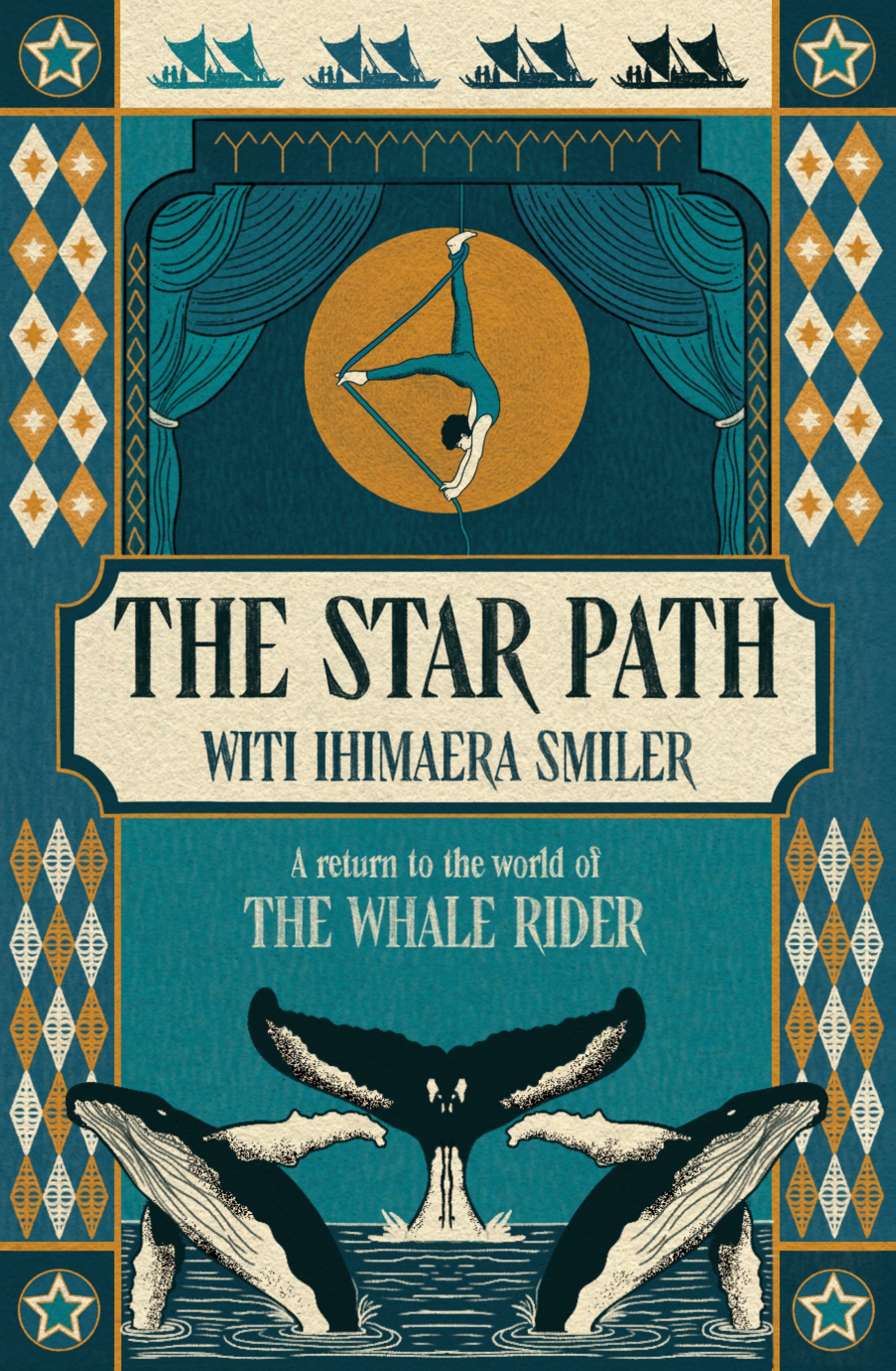
A young whale searches for the whale rider's heir and a teenager takes an epic voyage to Antarctica with a fleet of waka hourua to claim his lost inheritance, in this breathtaking return to the world of global hit The Whale Rider, over thirty years on.
From the internationally acclaimed author of The Whale Rider comes a novel about the pathways that guide us home.
Sixteen-year-old Teva has grown up between worlds. Raised in France, he knows almost nothing of his father’s Polynesian heritage — only that a family rift has kept them apart. But when his astonishing talent is discovered by a circus master, Teva's journey leads him across the Pacific and towards a destiny older than memory.
Deep within Antarctica’s treacherous ice mazes, the royal tribe of Mysticeti whales fears their ancient leader has brought them there to die. Decades earlier, he stranded them on the east coast of Aotearoa. As winter closes in, they must find the whale rider’s heir, the only one who can lead their chief back to warmer waters. But nobody knows who that is, let alone where they can be found.
Sweeping from France to French Polynesia, Aotearoa and Antarctica, The Star Path is a breathtaking new novel in which myth and reality, past and present, meet in an unforgettable story of identity, belonging and hope.
"A luminous joining of myth and contemporary culture." — Kirkus Reviews, on The Whale Rider
Witi Ihimaera Smiler is a prolific and accomplished New Zealand author whose body of work centring Māori culture and values has blazed a trail for Māori and indigenous writers around the world. He has published more than forty works for adults and children, including novels, memoir, non-fiction and short stories. Described by Metro magazine as ‘Part oracle, part memorialist,’ and ‘an inspired voice, weaving many stories together’, Ihimaera has also written for stage and screen – including libretti – edited books on the arts and culture and published a range of works for children.
His best-known novel is The Whale Rider, which was made into an internationally successful film in 2002. His novel Nights in the Gardens of Spain was made into the feature film Kawa, White Lies was based on his novella Medicine Woman and his novel Bulibasha, King of the Gypsies inspired the 2016 feature film Mahana.
His first book, Pounamu, Pounamu, has been continuously in print since its first publication in 1972. His works have received many awards over the years, including the Wattie Book of the Year and the Montana Book Award, and the Ockham Award for best non-fiction in 2016 for his first volume of memoir, Māori Boy. A second volume, Native Son, was published in 2019, the same year that Pūrākau, which he co-edited, was released: celebrating the work of other writers has also been an important part of Ihimaera’s focus. In 2020 he published his substantial nonfiction work, Navigating the Stars, and The Swimmer followed in 2026.
He has also had careers in diplomacy, teaching, theatre, opera, film and television.
He has received numerous awards for his contribution to literature. In 2004 he became a Distinguished Companion of the Order of New Zealand, and in 2009 he was awarded the inaugural Star of Oceania Award, University of Hawaii, a laureate award from the New Zealand Arts Foundation and the Toi Māori Tiketike Award. The Premio Ostana International Award was presented to him in Italy 2010. In 2017 France made him Chevalier de l'ordre des Arts et des Lettres and he received the New Zealand Prime Minister’s Award for Literary Achievement in Fiction.
On receiving the supreme Māori arts award Te Tohutiketike a Te Waka Toi, Ihimaera said, ‘To be given Māoridom’s highest cultural award, well, it’s recognition of the iwi. Without them, I would have nothing to write about and there would be no Ihimaera. So this award is for all those ancestors who have made us all the people we are. It is also for the generations to come, to show them that even when you aren’t looking, destiny has a job for you to do.’