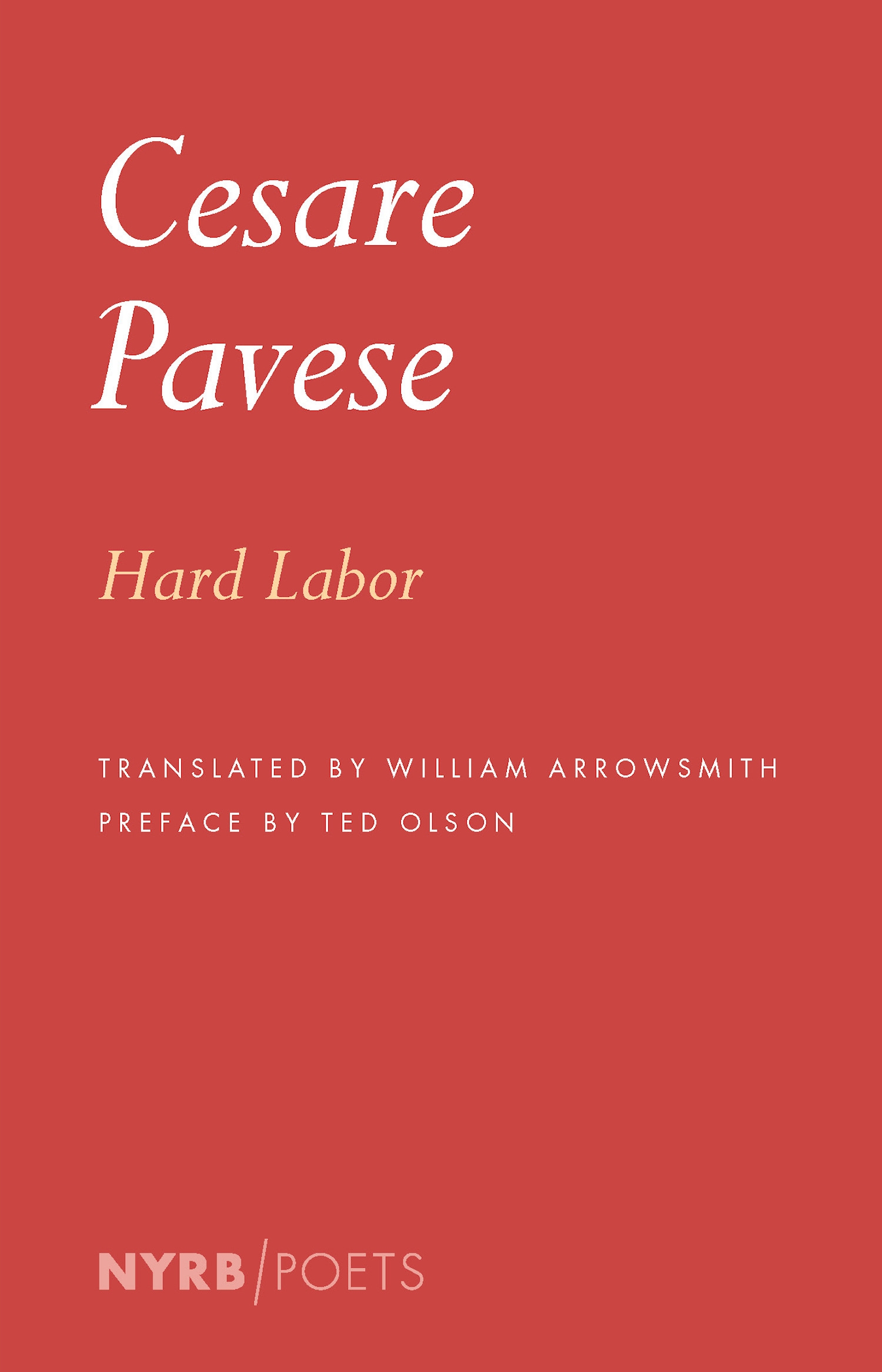
- Published: 24 June 2025
- ISBN: 9781681378787
- Imprint: NY Review Books
- Format: Paperback
- Pages: 272
- RRP: $45.00
Hard Labor


- Published: 24 June 2025
- ISBN: 9781681378787
- Imprint: NY Review Books
- Format: Paperback
- Pages: 272
- RRP: $45.00
"This Pavese translation, which I’ve just read, is a wonderful piece of work—the final effect of the 'plainness' is brilliancy. This is how writers in our ever-worsening world should write." —Saul Bellow
"A word about the translations of Pavese’s poetry by William Arrowsmith. They are just about as good as could be imagined…. It’s hard to analyze how Arrowsmith gets across Pavese’s 'still, sad music of humanity,' but it’s there. He even gets the pedal point that underlies the music of Pavese’s special melancholy." —Kenneth Rexroth, American Poetry Review
"William Arrowsmith is one of the century’s greatest translators. Arrowsmith’s introduction is the best essay on the bitter problem of poetic influence that I have encountered for some time. Anyone searching for insight into the war of American poets against their own tradition would benefit by reading Arrowsmith on Pavese." —Harold Bloom, New Republic
"I think the greatness of this book—and I am not using the word 'greatness' lightly—consists of Pavese’s nobility, and of the translator’s nobility. This book in English provides one of those strange occasions when the genius of a great man, in disturbing defiance of all arguments, proves its own miracle by rising from the dead in the genius of his translator. In an age which features stylistic adroitness, I hope that Mr. Arrowsmith’s translation will be widely read; for it reveals a language beyond adroitness: a noble language in English, appropriate to the great tragic poet whom it embodies." —James Wright
"William Arrowsmith, whose work with Greek drama has earned him an enviable reputation for scrupulousness and sensitivity as a translator, has approached Pavese as Pavese himself approached Melville, Joyce and Gertrude Stein with strict fidelity to the sense of the poet’s words rather than to the words themselves. He has rendered the poems of Hard Labor in a free‐wheeling colloquial American idiom that approximates the spirit of Pavese's Italian…There is nothing with quite this passionate intensity and purity in American poetry…. Hard Labor shows us Pavese at the outset of his own ultimately tragic career, writing poetry of courageous originality, intelligence, and power." —Jonathan Galassi, The New York Times
"Cesare Pavese is one of those singular, disruptive poets, like Blake or Lawrence, who go against the grain - or the flow - of their culture, and for whom precedents would be as hard to find as successors…. his marvellously peopled poems not only document the time—what Calvino called 'the Pavese era'—but also bear witness to a unique and restless intelligence." —Jamie McKendric, The Guardian
"Pavese’s appeal has on the reader an immediate and emotional hold. To return to these texts today is to confirm the power of an utterance that sends us back to something beyond poetry, but without which poetry could not exist." —Valerio Magrelli