> Skip to content
[]
  • Published: 16 May 2002
  • ISBN: 9780451523631
  • Imprint: Signet
  • Format: Paperback
  • Pages: 736
  • RRP: $22.99

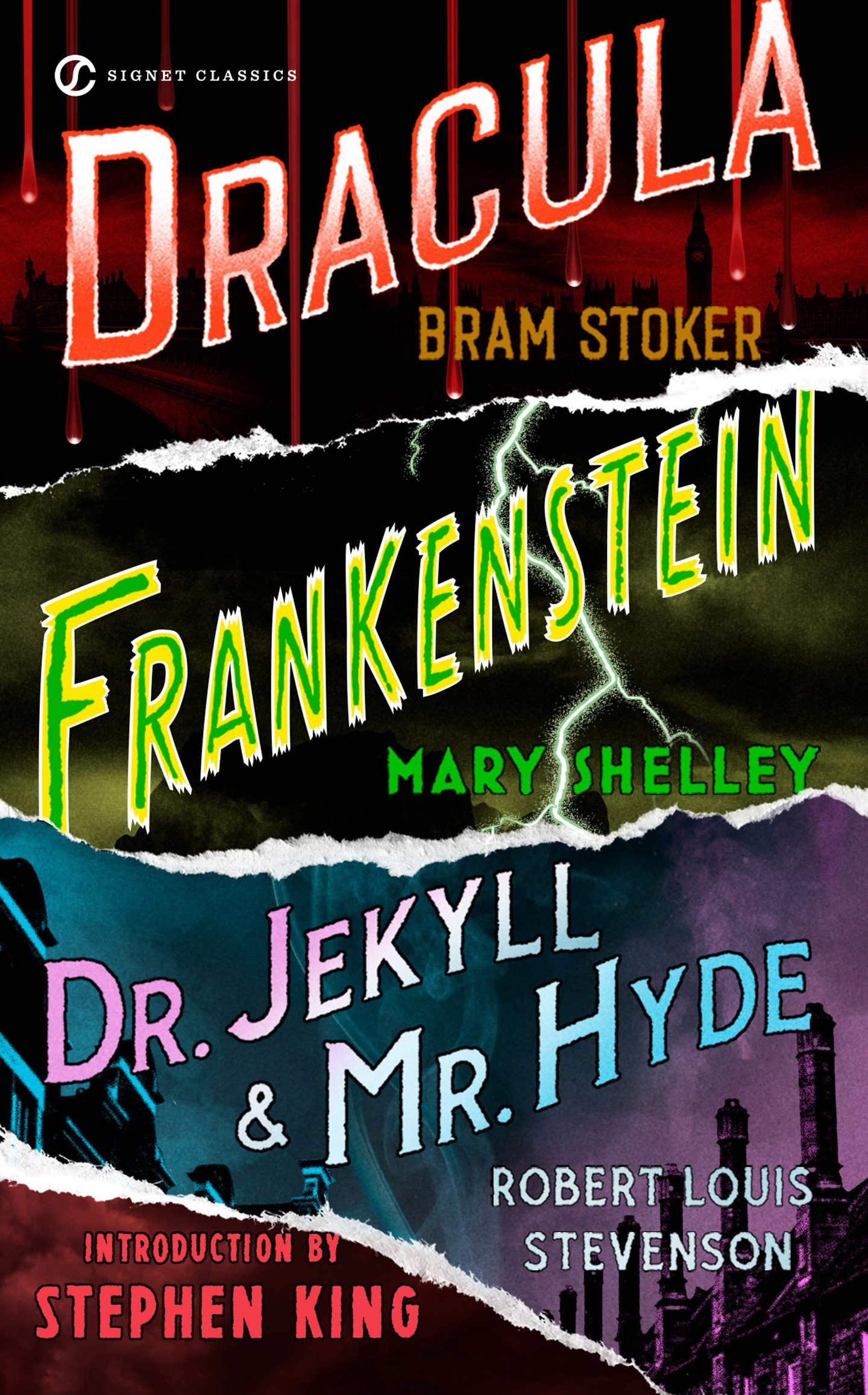
Frankenstein, Dracula, Dr. Jekyll and Mr. Hyde


Three horror icons come together in one indispensable tome—with an introduction by Stephen King.

Within the pages of this volume you will come upon three of the darkest creations of English nineteenth-century literature; three of the darkest in all of English and American literature, many would say…and not without justification…These three creatures, presented together for the first time, all have a great deal in common beyond their power to go on frightening generation after generation of readers…but that fact alone should be considered before all others.”—From the Introduction by Stephen King

A diabolical, bloodthirsty Count draws an unsuspecting young man into a world of terrors. A scientist oversteps the bounds of conscience and brings to life a tortured creation. A man of medicine explores his darker side only to fall prey to it. These three legendary tales have held readers spellbound for more than a century. 

The titles alone—Dracula, Frankenstein, and Dr. Jekyll and Mr. Hyde—have become synonymous with horror. They are part of a universal language that serves to put a monster’s face on the good-and-evil duality of our very human nature. Inventive and subversive, these classic tales of terror can shake even the modern reader with something far more profound than fear....
  • Published: 16 May 2002
  • ISBN: 9780451523631
  • Imprint: Signet
  • Format: Paperback
  • Pages: 736
  • RRP: $22.99

About the authors

Bram Stoker

Abraham Stoker was born in Dublin on 8 November 1847. He graduated in Mathematics from Trinity College, Dublin in 1867 and then worked as a civil servant. In 1878 he married Florence Balcombe. He later moved to London and became business manager of his friend Henry Irving's Lyceum Theatre. He wrote several sensational novels including novels The Snake's Pass (1890), Dracula (1897), The Jewel of Seven Stars (1903), and The Lair of the White Worm (1911). Bram Stoker died on 20 April 1912.

Mary Shelley

Mary Shelley was born in London in 1797, daughter of William Godwin and Mary Wollstonecraft, famous radical writers of the day. Mary’s mother died tragically ten days after the birth. Under Godwin’s conscientious and expert tuition, Mary’s was an intellectually stimulating childhood, though she often felt misunderstood by her stepmother and neglected by her father. In 1814 she met and soon fell in love with the then unknown Percy Bysshe Shelley, and in July they eloped to the Continent. In December 1816, after Shelley’s first wife, Harriet, committed suicide, Mary and Percy married. Of the four children she bore Shelley, only Percy Florence survived. They lived in Italy from 1818 until 1822, when Shelley drowned following the sinking of his boat Ariel in a storm. Mary returned with Percy Florence to London, where she continued to live as a professional writer until her death in 1851.
The idea for Frankenstein came to Mary Godwin during a summer sojourn in 1816 with Percy Shelley on the shores of Lake Geneva, where Lord Byron was also staying. She was inspired to begin her unique tale after Byron suggested a ghost story competition. Byron himself produced “A Fragment,” which later inspired his physician John Polidori to write The Vampyre. Mary completed her short story back in England, and it was published as Frankenstein; or, The Modern Prometheus in 1818. Among her other novels are The Last Man (1826), a dystopian story set in the twenty-first century, The Fortunes of Perkin Warbeck (1830), Lodore (1835), and Falkner (1837). As well as contributing many stories and essays to publications such as the Keepsake and the Westminster Review, she wrote numerous biographical essays for Lardner’s Cabinet Cyclopaedia (1835, 1838–39). Her other books include the first collected edition of Percy Bysshe Shelley’s Poetical Works (4 vols., 1839) and a book based on the Continental travels she undertook with her son Percy Florence and his friends, Rambles in Germany and Italy (1844). Mary Shelley died in London on February 1, 1851.

Robert Louis Stevenson

Robert Louis Stevenson was born in Edinburgh in 1850. Chronically ill with bronchitis and possibly tuberculosis, Stevenson withdrew from Engineering at Edinburgh University in favour of Studying Law. Although he passed the bar and became an advocate in 1875, he knew that his true work was as a writer. Between 1876 and his death in 1894, Stevenson wrote prolifically. His published essays, short stories, fiction, travel books, plays, letters and poetry number in dozens. The most famous of his works include Travels With A Donkey in the Cevennes (1879), New Arabian Nights (1882), Treasure Island (1883), The Strange Case of Doctor Jekyll and Mr Hyde (1887), Thrawn Janet (1887) and Kidnapped (1893). After marrying Fanny Osbourne in 1880 Stevenson continued to travel and to write about his experiences. His poor health led him and his family to Valima in Samoa, where they settled. During his days there Stevenson was known as ‘Tusitala’ or ‘The Story Teller’. His love of telling romantic and adventure stories allowed him to connect easily with the universal child in all of us. ‘Fiction is to grown men what play is to the child,’ he said. Robert Louis Stevenson died in Valima in 1894 of a brain haemorrhage.