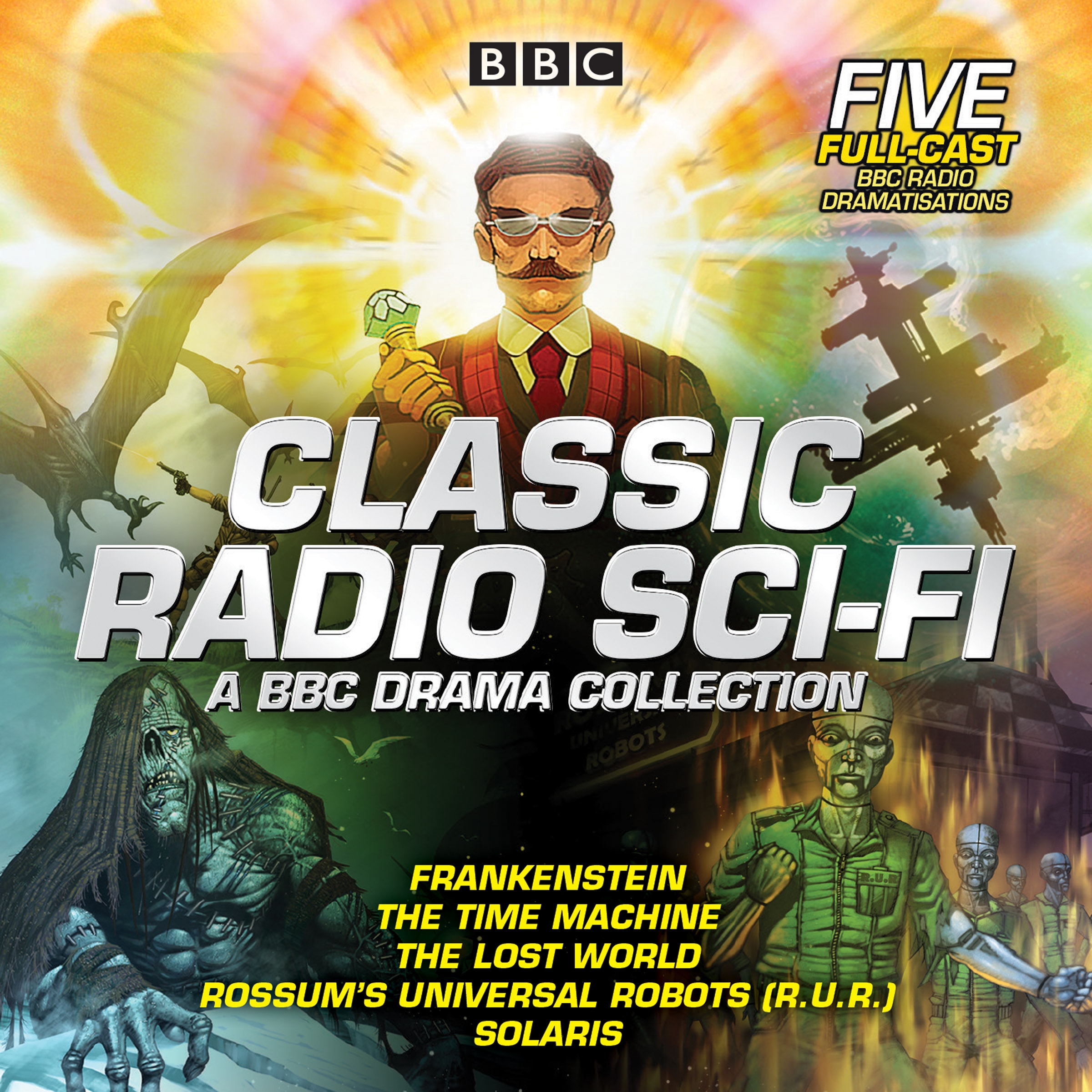
Five seminal science fiction classics are brought vividly to life in these gripping BBC Radio dramatisations.
Five seminal science fiction classics are brought vividly to life in these gripping BBC Radio dramatisations, with casts including Robert Glenister, William Gaunt, Carleton Hobbs and Joanne Froggatt. \"Frankenstein\" (1994) is adapted from one of the first science fiction novels, Mary Shelley's tale of a scientist who tries to play God and creates a monster. \"The Time Machine\" (2009) dramatises one of the first stories to feature time travel, HG Wells' thrilling tale of an inventor who discovers a dystopian future. \"The Lost World\" (1975) is based on a classic fantasy adventure story by Arthur Conan Doyle's, whose notion of dinosaurs roaming our world was the inspiration for Jurassic Park. \"R.U.R.\" (1989) is a radio production of Karel Capek's thought-provoking play which introduced the word 'robot' to the English language. \"Solaris\" (2007) dramatises Stanislaw Lem's pioneering ghost story set in space, both a suspenseful thriller and a philosophical meditation on guilt and the human condition. Accompanying this collection is a bonus PDF file featuring extensive sleeve notes by Andrew Pixley. Duration: 10 hours approx.
Published: 1 June 2017
ISBN: 9781785296239
Imprint: BBC DL
Format: Audio Download
Length: 9 hr 45 min
Narrators: Robert Glenister, William Gaunt, Joanne Froggatt
English novelist, journalist, sociologist, and historian, whose science fiction stories have been filmed many times. WELLS’ best known works are THE TIME MACHINE, one of the first modern science fiction stories, THE INVISIBLE MAN, and THE WAR OF THE WORLDS. Wells wrote over a hundred of books, about fifty of them novels.
H.G. Wells was born in Bromley, Kent, in 1866. After an education repeatedly interrupted by his family’s financial problems, he eventually found work as a teacher at a succession of schools, where he began to write his first stories.
Wells became a prolific writer with a diverse output, of which the famous works are his science fiction novels. These are some of the earliest and most influential examples of the genre, and include classics such as The Time Machine and The War of the Worlds. Most of his books very well-received, and had a huge influence on many younger writers, including George Orwell and Isaac Asimov. Wells also wrote many popular non-fiction books, and used his writing to support the wide range of political and social causes in which he had an interest, although these became increasingly eccentric towards the end of his life.
Twice-married, Wells had many affairs, including a ten-year liaison with Rebecca West that produced a son. He died in London in 1946.
Mary Shelley was born in London in 1797, daughter of William Godwin and Mary Wollstonecraft, famous radical writers of the day. Mary’s mother died tragically ten days after the birth. Under Godwin’s conscientious and expert tuition, Mary’s was an intellectually stimulating childhood, though she often felt misunderstood by her stepmother and neglected by her father. In 1814 she met and soon fell in love with the then unknown Percy Bysshe Shelley, and in July they eloped to the Continent. In December 1816, after Shelley’s first wife, Harriet, committed suicide, Mary and Percy married. Of the four children she bore Shelley, only Percy Florence survived. They lived in Italy from 1818 until 1822, when Shelley drowned following the sinking of his boat Ariel in a storm. Mary returned with Percy Florence to London, where she continued to live as a professional writer until her death in 1851. The idea for Frankenstein came to Mary Godwin during a summer sojourn in 1816 with Percy Shelley on the shores of Lake Geneva, where Lord Byron was also staying. She was inspired to begin her unique tale after Byron suggested a ghost story competition. Byron himself produced “A Fragment,” which later inspired his physician John Polidori to write The Vampyre. Mary completed her short story back in England, and it was published as Frankenstein; or, The Modern Prometheus in 1818. Among her other novels are The Last Man (1826), a dystopian story set in the twenty-first century, The Fortunes of Perkin Warbeck (1830), Lodore (1835), and Falkner (1837). As well as contributing many stories and essays to publications such as the Keepsake and the Westminster Review, she wrote numerous biographical essays for Lardner’s Cabinet Cyclopaedia (1835, 1838–39). Her other books include the first collected edition of Percy Bysshe Shelley’s Poetical Works (4 vols., 1839) and a book based on the Continental travels she undertook with her son Percy Florence and his friends, Rambles in Germany and Italy (1844). Mary Shelley died in London on February 1, 1851.