- Published: 28 January 2026
- ISBN: 9781761345098
- Imprint: Penguin
- Format: Trade Paperback
- Pages: 352
- RRP: $36.99
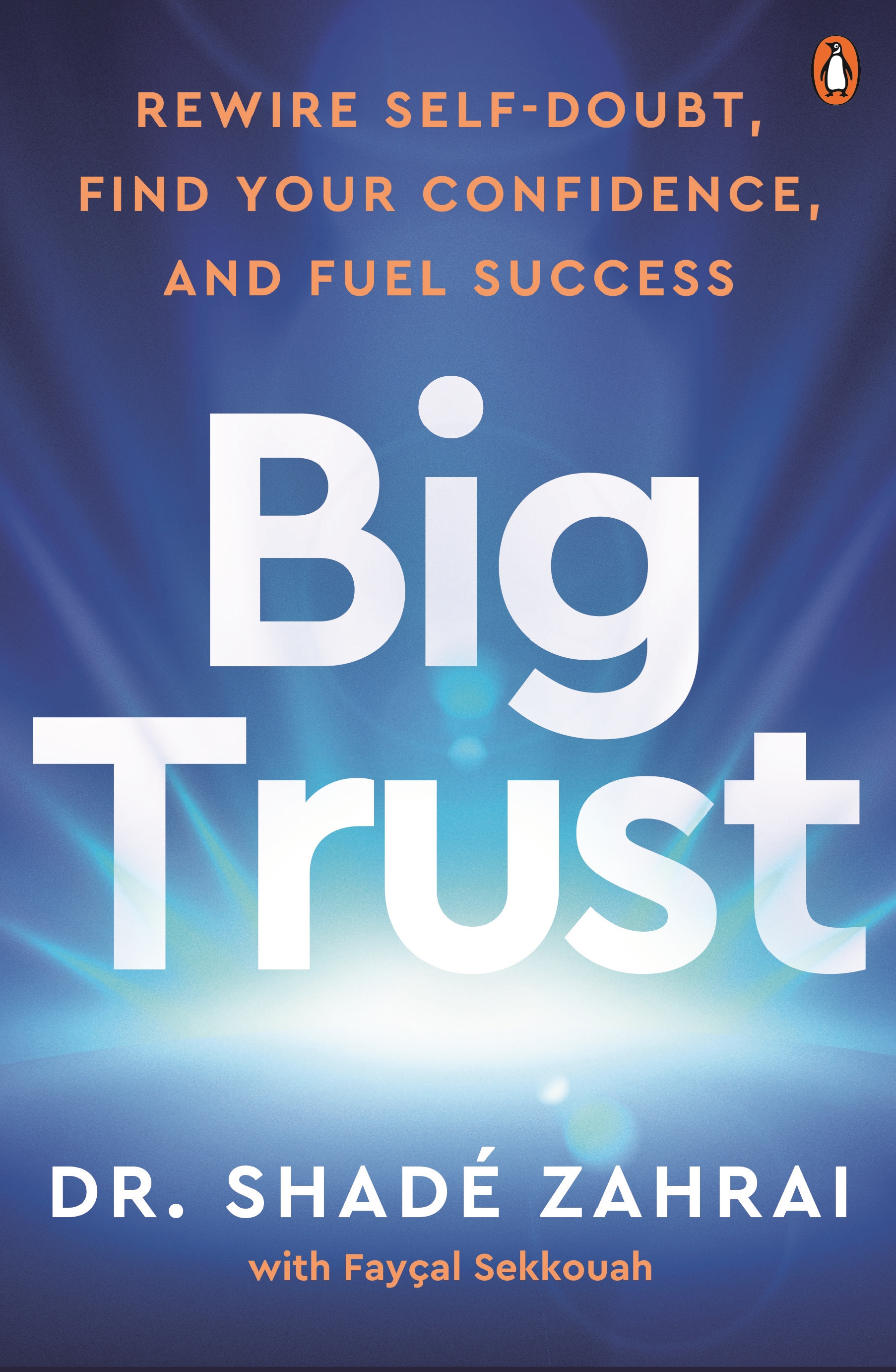
Big Trust
Rewire Self-Doubt, Find Your Confidence and Fuel Success: As featured on The Mel Robbins Podcast
Extract
Earlier that day, I’d been working on a program about accelerating career growth. The topics sounded great on paper, but something about it felt . . . off.
For years, I’d shared frameworks, strategies, and motivational fuel that lit people up and helped them take action. Yet I was midway through my work with this group of mid-career professionals, and I had a gnawing sense that my approach was missing the mark, that it would ignore their deeper frustrations and worries.
Across the board, I knew they weren’t just stuck in their careers; they were stuck in themselves. And honestly, I’d been there too. The grind without the growth. The effort without the results. That maddening sense of pouring yourself into something and still feeling like it’s not enough.
This sinking feeling was reminding me of one of my earliest encounters with self-doubt. I was nineteen, sitting in a Legal Jurisprudence class at Macquarie University in Sydney, Australia, and everything about it felt wrong. I had chosen law because I had the grades and because everyone said, “Don’t waste them.” My parents, my teachers, my immigrant grandparents who had fled Iran to build a life in the West— they all had visions of “lawyer” or “doctor” for my future. To balance things out, I paired law with a psychology degree, something that actually made sense to me. Human behavior had always fascinated me.
But on that first day of university, as I sat in class, law felt foreign— like a mistake. No, I felt like the mistake. My classmates tossed out answers while I scrambled to keep up, barely grasping the jargon, let alone the concepts. Heat rushed to my face. The insecurities I hadn’t realized were lurking beneath the surface roared to life:
I don’t belong here.
I’m not smart enough.
I’ll never be able to keep up.
The moment class ended, I practically ran to the department advisor’s office. The words spilled out before I could stop them: “I don’t understand anything— I need to drop law.”
I expected encouragement. Reassurance. Someone to remind me it was just the first day, that I’d find my footing soon enough. Maybe even that I was smarter than I thought. I didn’t admit it to myself, but I had wanted the advisor to take my self-doubts away, to “fix” things for me. What I got instead was silence. Then she handed me a course withdrawal form.
It felt like a punch to the gut. Like she saw someone who was not worth believing in.
I didn’t drop law, though. I walked out of her office feeling humiliated but also strangely defiant. I didn’t want her (or anyone) to see me as someone who couldn’t handle it. So I pushed myself. I worked harder. Stayed up later. Powered through moments of doubt, convinced that achievement would eventually silence the insecurities.
Of course, it didn’t. (As I’ve since learned, so many others try, and fail, to do the same.)
Self-doubt followed me from law school into corporate law, where everything felt so hard. It followed me into my banking career, where I thought a career change might leave the doubt behind.
It didn’t.
It shadowed me in meetings, silencing ideas I wanted to share. It was the anxious churn in my stomach, the overthinking that ruined my sleep, the constant second-guessing that never let up.
Even when opportunities came my way, I rationalized my way out of them. I’m not ready. The timing’s not right. I told myself I was being cautious and wise. But really, it was fear. Fear wrapped in overthinking. Fear moonlighting as prudence. And still, I pushed myself, trying to drown out doubts that refused to let go.
That night, as I laid in bed all those years later, eyes locked on the faint glow of my phone screen, those memories resurfaced.
Then, it hit me. What if I’ve been asking the wrong question all along?
Maybe it’s not about how to go faster or push harder. Maybe the real question is: Why am I stuck in the first place?
If I could figure out what was holding me back—what was really in the way—I knew I could help others move forward with their own struggles in a way that felt lighter. Less forced. Instead of feeling panic or dread that there was something missing in my work, I felt something else. Relief. Clarity. Possibility. Maybe there was another way, and I was ready to find it.
The Stickiness of Self-Doubt
Over the years, I learned, on a personal level, how to push past my own self-doubt. One step at a time, I rebuilt my career, strengthened my confidence, and achieved milestones I once thought were out of reach. I went back to university, earned credentials, and became a peak performance specialist, behavioral strategist, executive coach, and researcher, building a career in helping others unlock their potential.
But it occurred to me that maybe my perspective was too narrow. For years, my work (and my own path) had focused heavily on the visible markers of success: landing the promotion, hitting the next career milestone, achieving a major life goal. These were the outcomes people sought, the things that felt like the solution to their self-doubt. And I was helping them get there. And yet, even when clients reached their goals, something was missing. Their self-doubt didn’t lift (and neither did mine). If anything, it evolved, morphing into new fears, new insecurities, new thresholds of “not enough.”
So, in the quiet of that night, I tapped out a question on my phone. A simple, provocative thought that I sent to a list of a few hundred psychologists, performance coaches, and professors:
“If you wanted to sabotage someone’s success and happiness, what’s the most effective way to do it?”
By morning, forty-eight responses had poured in. They were blunt, unfiltered, and eerily similar, saying things like:
“Make them overthink until they’re paralyzed by indecision.”
“Plant seeds of self-doubt so they question every move they make.” “Get them to compare themselves with others and feel like they’re never enough.”
“Constantly remind them of their weaknesses so they lose faith in themselves.”
“Convince them they’re insignificant, so they shrink away from their potential.”
Different words, same conclusion: To sabotage anyone’s potential, cultivate self-doubt. It doesn’t take grand, elaborate schemes. Just plant a tiny seed of self-doubt, and it will take root—it will stick. A person’s mind will handle the rest.
Let me tell you a story that demonstrates how self-doubt sticks around. At the end of 2021, my husband, Fayçal, and I rescued a stray dog. We named her Bonbon—French for “candy,” because she’s as sweet as they come. Plus, as French is Fayçal’s first language, the name just felt right. Bonbon quickly became part of our world. And so did an unexpected daily ritual.
Every walk through the fields near our home left us covered in burrs. These tiny, seeded pods were absolute nuisances. They’d become entangled in Bonbon’s fur, my socks, even my hair. Every day, without fail, we’d sit and pick them out, one by one.
Turns out, this wasn’t just our problem.
Back in 1941, a Swiss engineer named George de Mestral went hiking with his dog and came home covered in burrs too. But instead of just being annoyed, he got curious. Under a microscope, he discovered that these annoying little things had tiny, barbed hooks that latched onto anything they touched. His eureka moment led to what we now know as Velcro.
Here’s the thing about burrs: They don’t just stick. They cling. Relentlessly. Stubbornly. Almost impossibly. And so does self-doubt.
It starts small. A passing thought, something you could easily brush off. Then it hooks in. It tangles its way into your decisions, your confidence, even the way you see yourself. Left unchecked, self-doubt becomes part of your mental operating system. It runs quietly in the background, shaping your choices without you even realizing it. This is where self-doubt turns toxic. Instead of keeping you vigilant, it makes you second-guess everything.
Like my clients did.
Like I did.
Like I’m guessing you do.
The mistake isn’t having self-doubt. The mistake is thinking you have to defeat it.
You don’t overcome self-doubt by silencing it—though that’s what too many of us believe (and too many “experts” teach). You take away its power by noticing it, understanding it, and changing your relationship to it. You unhook from self-doubt when you see it for what it is: a misguided attempt to protect you. That’s the irony. Self-doubt isn’t trying to sabotage you; it’s trying to shield you.
When channeled the right way, self-doubt can be useful. It’s like a friend in the passenger seat. The “good” kind leans over and says, “Hey, your fuel light just came on—better find a gas station soon.” The “bad” kind is the obnoxious backseat driver who won’t shut up, insisting you take the next exit, even though your GPS is clearly right. The longer you listen to that voice in the backseat, the more convincing it becomes. Maybe I really am lost. Maybe I shouldn’t be driving at all.
The truth is that the world we live in today is perfectly engineered to amplify self-doubt. We’re more exposed than ever—scrolling through curated lives, juggling blurred lines between public and private selves, bombarded with messages about “making it” and endlessly upgrading ourselves. It’s no wonder self-acceptance feels almost . . . impossible.
More success doesn’t erase the doubt. More knowledge doesn’t silence it. And despite all our modern tools, psychological insights, and endless “life hacks,” self-doubt isn’t getting easier to manage; it’s getting louder. And there’s a reason why. Self-doubt isn’t something you can block out or ignore. It’s something you have to acknowledge. What I’ve learned—from my own life, from the research, and from the thousands of people I’ve worked with—is that, under-stood correctly, listened to well, and transformed wisely, self-doubt can be one of your greatest tools for growth.
Big Trust Shadé Zahrai, Fayçal Sekkouah
'I cannot wait to see how this changes your life. There is zero doubt in my mind that when you use the tools to rewire self-doubt . . . your life is going to get better.' Mel Robbins'This book will change the way you lead yourself and others.' Sahil Bloom, bestselling author of The 5 Types of Wealth'Science-backed and easy to put into practice, this book hands you a game-plan that actually works.' Jefferson Fisher, bestselling author of The Next Conversation'Practical, powerful, memorable and deeply human.' Vinh Giang THE GROUNDBREAKING, RESEARCH-BACKED BLUEPRINT CHANGING LIVES AND CAREERS AROUND THE WORLD.
Buy now