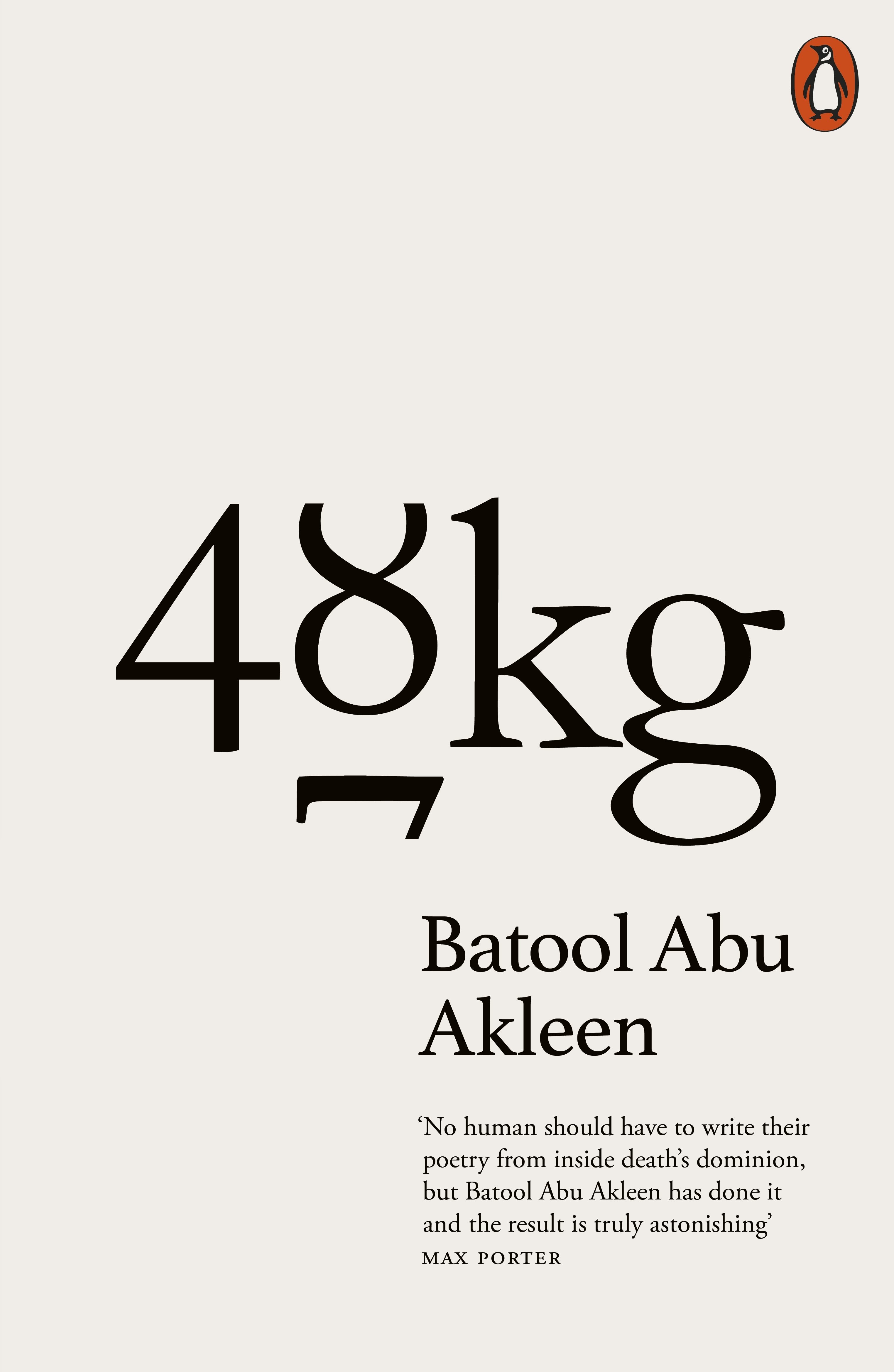
- Published: 26 January 2027
- ISBN: 9781837315185
- Imprint: Penguin Press
- Format: Paperback
- Pages: 128
- RRP: $24.99
48kg


- Published: 26 January 2027
- ISBN: 9781837315185
- Imprint: Penguin Press
- Format: Paperback
- Pages: 128
- RRP: $24.99
About the author

One of the most viscerally affecting collections of poems I have ever read. Devastatingly precise and unforgettable images emerge from every line… What is happening in Gaza is a genocide not a war, but not since Akhmatova have I read poetry that so potently reckons with the relationship between war and the body. They create a new category of literary grace out of the cataclysm. These are poems of fire and agony, bombing and starvation, but they are also poems of grace, cleverness, tenderness and yearning. A great international poet arrives with this collection, but it is also a landmark work of resistance. No human should have to write their poetry from inside death's dominion, but Batool Abu Akleen has done it, and the result is truly astonishing
Max Porter
Abu Akleen is becoming one of Gaza's most vivid and unstinting witnesses
Claire Armistead, The Guardian
Batool Abu Akleen has written the impossible thing—an unbelievably hard portrayal in poems of the daily attack on Gaza while living inside it—and her poems warp and play relentlessly with language in all its rare contrarity, its entire animal ancient, while sharing the inky humour and sweetness of her own new poet’s practice. For me, only Etel Adnan’s Arab Apocalypse can be compared to 48kg in its biting frankness and bravery; her words are coming straight from today.
Eileen Myles
The poets of Palestine have become vital archivists. In 48Kg Batool Abu Akleen not only provides brute testimony of the Genocide committed by Israel against her people, but by her inventiveness and surreality, by the barbed humour and bitter irony of her voice, and the tender revelation and humane wisdom of her work, she defiantly gives voice and futurity to Palestinian life. She writes that she waits for death, ‘like a mother expecting her newborn’ telling us ‘I will scream / I will feel his head coming out of my body.’ No one should have to write these incredible, haunting lines, but everyone should read them. This is an extraordinary book of poetry
Jack Underwood
These poems witness dispossession so profound, the poet longs even for certainty that her body will rest in a grave. This searing fact is the heart of 48Kg
Anne Michaels
Written in Gaza between 2023 and 2025, Abu Akleen’s poems disassemble and painstakingly reassemble the body to interrogate injustice, death and grief. She creates a world where absurdity and reality, irony and humanity coexist—from the ice-cream man crying out ‘corpses for sale’ while noting that ‘no grave buys them,’ to death wanting to have a birthday party and picking ‘an arm the missile hadn’t shattered' .... Throughout 48Kg, Abu Akleen transforms witnessed details into fragile interpretations .... She notes that poetry gives ‘a form to feelings in order to understand them,’ and these heartbreaking and risk-taking poems protest with uncompromising clarity and tenderness against continuing atrocities
Kit Fan, The Guardian
Batool Abu Akleen’s roaming verse contemplates whether absurdism is the only language we have left to express this vicious genocide
Hasib Hourani
Objects and emotions tangle brilliantly in these searing poems. It’s terrible that Abu Akleen has atrocities to write about, and how well she does it
Caryl Churchill
Batool Abu Akleen's poetry is both tragic and eloquent. No words can convey Gaza's ordeal, but her spare verses give it a life and meaning beyond words. The lines compel the reader's attention and empathy
Ghada Karmi
Like lines of Emily Dickinson, Batool Abu Akleen’s astonishing work combines electric imagery with naked-wire directness to say that, when ‘nothing remains but the fire,’ the one thing you can trust is poetry
Ruth Padel
In 48Kg, lines ebb and flow with a vital pulse ... wielding alliteration and assonance to unforgettable effect ... What a heartrending thing it is to read a debut collection already braced for posterity—yet what a privilege it is to have these extraordinary poems, in spite of all
Samuel Martin, Hopscotch Translation
Where prior literary icons mythologised the land or the martyr, Abu Akleen scales Gaza down to the weight of a starving female body. Her poetics are granular, skeletal, and radically intimate... Central to this work is the gendered experience of survival. Unlike heroic, masculine renderings of martyrdom or battle, Abu Akleen’s voice inhabits the soft infrastructures of war—kitchens, beds, toilets, menstrual blood... Time in 48Kg. is erratic. Space is claustrophobic. Bodies vanish incrementally rather than explosively. This is a literature not of spectacle but of slow erasure … Abu Akleen’s singular voice is a rupture … Its formal refusal of narrative cohesion contrasts with the epistolary shape of communal grief. The result is a poetics that does not explain Gaza to the world but carves Gaza into the body of language itself.
Alaa Alqaisi, The Avery Review
Abu Akleen’s bilingual collection of poems, 48kg, is not solely a powerful literary work; rather, it is a testimony of the genocide that has been wrought upon Gaza for the past two years, written in a poetic verse and style. Her writing is urgent, heartbreaking, honest, and brutal; every line lingers long after reading ... Her poems not only represent her personal recollections of the everyday struggle, but also mirror the collective story of the Palestinian people in Gaza and their survival over the last two years. Her narrative voice is both personal and collective, embodying the voices of the countless victims whose names we did not learn. Through this double approach, the poems are both an intimate testimony of Akleen’s experience and a form of collective witness, often blurring the line between the author and the unknown victim
Christina Chatzitheodorou, Asymptote
This collection by a brave extraordinarily gifted Palestinian woman, wise beyond her years, is a searing and urgent cry of the heart and conscience; a call to wake the world up to itself. Batool Abu Akleen’s fierce love for her country and people are thunderbolts of compassion and power, and the relevance of poetry is never stronger than in her luminous details of life and struggle. We live within a crisis of humanity, and we need her antidote; a shield against cruelty and silence in the disaster narratives of War. There must be poetry and consciousness after atrocity. You will weep and will weep and weep again. You will want to stop the world.
Anne Waldman
Batool Abu Akleen’s 48kg is a gorgeous, desperate cry from a visionary young poet living amid apocalypse. This urgent collection, penned in Gaza under genocide, is at once grief stricken with the weight of Palestinian death and triumphant in its reclamation of language as a means of preserving Palestinian life. A beautiful, harrowing read
Hannah Lilith Assadi
The most horrifying, exquisite and staggering poems I have ever read ... This essential poetry of witness stares into the abyss, and we must look in the direction it looks
Mícheál McCann, The Irish Times