One of our most daring intellectuals offers a Lacanian interpretation of religion, finding that early Christianity was the first revolutionary collective.
Slavoj Žižek has been called "an academic rock star" and "the wild man of theory"; his writing mixes astonishing erudition and references to pop culture in order to dissect current intellectual pieties. In The Puppet and the Dwarf he offers a close reading of today's religious constellation from the viewpoint of Lacanian psychoanalysis. He critically confronts both predominant versions of today's spirituality—New Age gnosticism and deconstructionist-Levinasian Judaism—and then tries to redeem the "materialist" kernel of Christianity. His reading of Christianity is explicitly political, discerning in the Pauline community of believers the first version of a revolutionary collective. Since today even advocates of Enlightenment like Jurgen Habermas acknowledge that a religious vision is needed to ground our ethical and political stance in a "postsecular" age, this book—with a stance that is clearly materialist and at the same time indebted to the core of the Christian legacy—is certain to stir controversy.
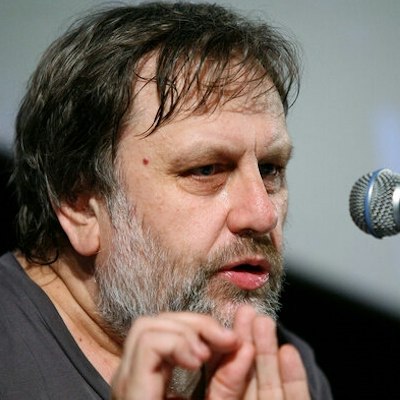
Philosopher and cultural critic SLAVOJ ŽIŽEK is internationally recognized for his works on psychoanalysis, Hegel, cinema, political theory, and current events. He teaches at the European Graduate School and has been a visiting professor at Université de Paris VIII, Columbia, and Princeton, among other institutions. He is founder and president of the Society for Theoretical Psychoanalysis in Ljubljana, Slovenia, and is the author of many books on topics ranging from Christianity to the films of David Lynch. His books include God in Pain: Inversions of the Apocalypse, Like a Thief in Broad Daylight: Power in the Era of Post-Human Capitalism, and Too Late To Awaken: What Lies Ahead When There Is No Future?, all three published by Seven Stories Press