- Published: 6 October 2026
- ISBN: 9781761352607
- Imprint: Penguin
- Format: Trade Paperback
- Pages: 480
- RRP: $36.99
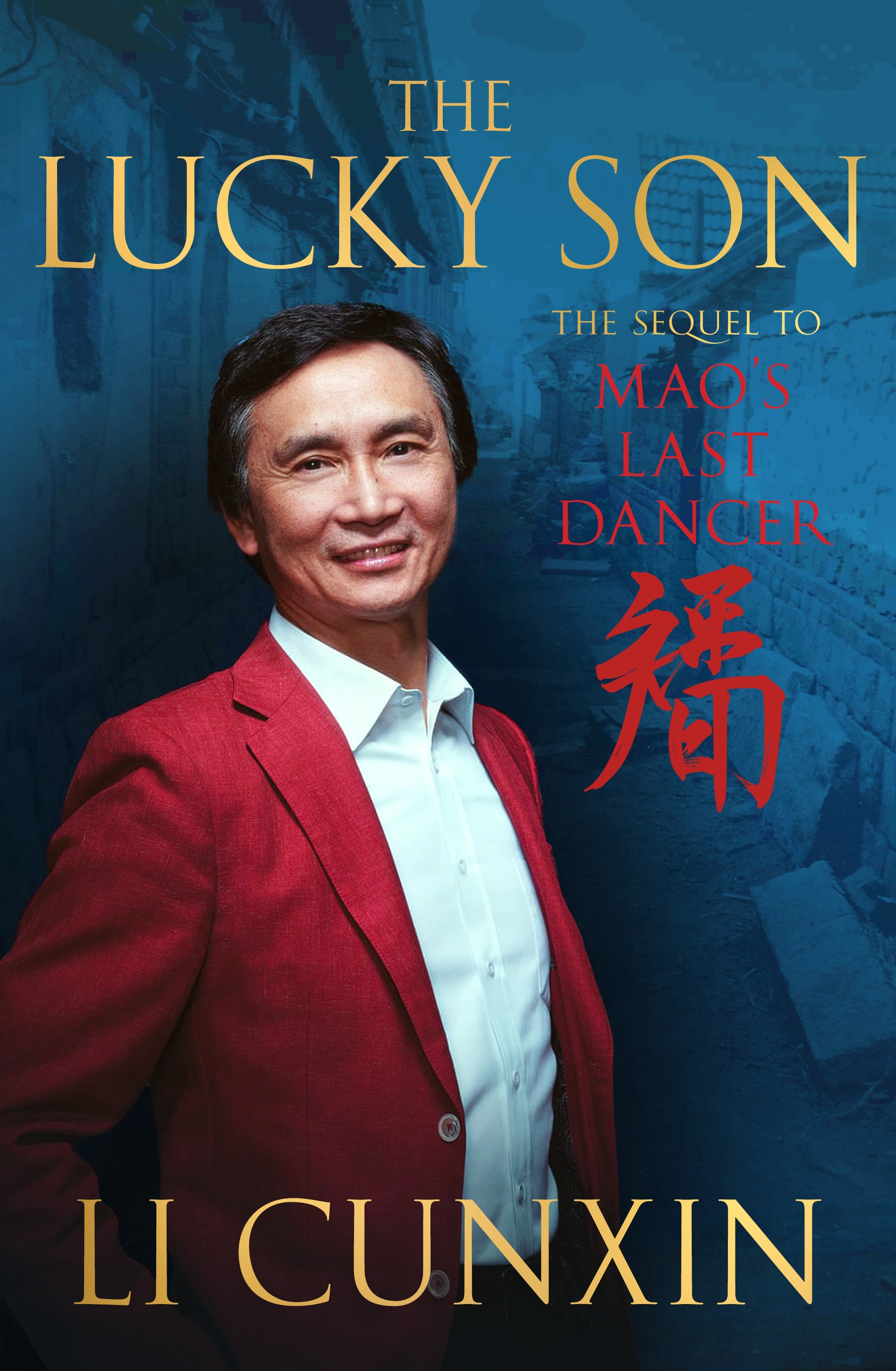
The Lucky Son
The Sequel to Mao’s Last Dancer
Extract
Preface
Never could I have imagined as a poor peasant boy in China the turns my life would take – nor that the story of my life would one day reach and move readers and audiences around the world. I was born in Mao’s communist China in 1961 at a time when the country was suffering one of the worst famines the world has ever seen, where tens of millions of people died of starvation and disease. My parents, uneducated peasants who couldn’t read or write, struggled to survive and keep alive their seven sons. I was the sixth of seven.
One fateful day in 1971, Madame Mao’s cultural delegates visited my classroom looking for young peasants to mould into faithful guards of Chairman Mao’s great vision for China. We were asked to stand up and sing ‘We Love You Chairman Mao’ while the delegates examined each of us. They passed me by and only selected one girl, but as they were walking out my class teacher hesitated and suddenly tapped the shoulder of the last official. ‘What about that one?’ she said. And that one was me.
That moment changed my life beyond my wildest dreams. At the age of eleven I left my beloved mother Niang, my father Dia, six brothers and all I ever knew behind, and travelled to Beijing to study at Madame Mao’s Beijing Dance Academy. Seven years of gruelling training followed, brutal and lonely. I missed my family so much and often cried myself to sleep. But the academy’s training regime taught me the importance of discipline and resilience. Eventually I went from hating ballet to falling in love with it, all because of the kindness, inspiration and encouragement of one extraordinary teacher: Teacher Xiao. During those tough years I also forged lifelong friendships, which included a fellow student nicknamed the Bandit. We were kindred spirits and formed an unbreakable bond of blood-brotherhood.
Through passion, dedication and relentless hard work, I progressed from being the laughing-stock of the academy to becoming one of its premier dancers. When I graduated in 1979 I was considered by some to be the young Baryshnikov of China.
Later that year I was discovered by Ben Stevenson, a highly regarded American ballet director who was on a professional visit to China. At the age of eighteen I was one of the first cultural-exchange students ever permitted to leave communist China to study with Ben at Houston Ballet. America was a new world – and I was the frog that managed to escape the confines of his well in my father’s ‘Frog in the Well’ story of my childhood. In that story, a frog on land sings the praises of his expansive world to a frog that dwells at the bottom of a small well unaware of his fated confinement. I had found life beyond the well, and felt so incredibly fortunate.
While there, I fell in love and married an American ballet student, Elizabeth Mackey, without realising the consequences. I was held against my will inside the Chinese Consulate in Houston for over twenty-one hours for refusing to return to China – the longest hours of my life! My future was hanging by the thinnest thread. My defection involved the top levels of both the American and Chinese governments to negotiate my release.
After virtually giving up all hope of ever being able to see my family and friends in China again, it was a miracle I walked out of the Chinese Consulate a free man. This second big chance in my life inspired such appreciation and gratitude. I vowed to treasure my freedom and make the very most of this gift of life. In the West my ballet career flourished, and I became one of the world’s most celebrated dancers.
Amidst my torment, despite our love for each other my marriage to Elizabeth came to an end. I felt like a failure, and more alone than ever. I poured myself into my work – Ben Stevenson and Houston Ballet became my new family.
Five years after my defection, Houston Ballet performed Swan Lake at the Kennedy Center in Washington, D.C. A few days before opening night, Vice President George H.W. Bush’s wife, Barbara, who was on the Houston Ballet board, invited Ben and me to the White House for coffee. I had met Barbara before, and she always took a special interest in me as she had spent some time in China. At one point, she asked me about my family. I got emotional and didn’t know what to say. I had no idea then, but it was thanks to Barbara Bush that after years of heartbreaking separation I would one day have the most unforgettable reunion with my parents – in Houston, a city so far and so vastly different from Qingdao.
My mother and father arrived on the night of the opening performance of The Nutcracker – one of the most special and memorable performances of my entire life. Dancing in front of my niang and dia was something to cherish, for as long as I lived. At that moment life was full of colour – I was the happiest person on earth. I danced as I had never danced before, with complete freedom and elation. I soared into the air and my heart filled with joy and happiness. That night, my tears washed away years of my sadness, loneliness and guilt. With my parents resting in the next room, for the first time in a long time I slept with a big smile on my face.
Around this time, I also found new love. Unknowingly, Mary McKendry and I had crossed paths in my final year at the Beijing Dance Academy when she visited China to perform with the English National Ballet. Several years later I travelled to London to perform, and met Mary properly. Ben was raving about this Australian ballerina he had worked with a few years prior. I went to see her perform, and she was sublime. A fanciful thought occurred: wouldn’t it be nice to dance with her one day?
A year later Ben invited Mary to join Houston Ballet. We soon struck up a special dance partnership, and eventually this professional relationship evolved into a personal one – we fell deeply in love, and married in 1987. We were so happy! Life couldn’t be more perfect for us. We felt like the luckiest couple in the world, so blessed to find each other.
In 1988 I finally received permission from the Chinese government to visit my family in China. I had dreamt of this moment so often, but now another impossible dream was going to come true – Mary was to accompany me. As the plane descended at Qingdao Liuting International Airport, the very place I’d once dug for half-burnt coals and nearly got shot by the guards, my heartbeat quickened, and I was beside myself with nervousness and excitement. The cloudless sky, the distant mountains, the familiar smell of sea-saltiness, the stifling midsummer air and the friendly Qingdao dialect all made me nostalgic.
As we wheeled our luggage towards the exit, I could see my brothers’ heads pop up and down amongst the crowd like yo-yos. ‘Jing Hao! Jing Hao!’ They called my family nickname with much excitement. There was a large contingent to welcome us: five of my six brothers, their wives, and some nieces and nephews. It was a much-longed-for reunion for me, and an unforgettable first encounter for Mary. After my defection, none of us had thought this day would ever come.
Memories flooded back as we passed the communes and terraced fields. I could still glimpse that little boy running barefoot and wild under the hot summer sun, the unbearable harsh sub-zero winter and snow-covered ground, and the bitter starvation– all so vivid in my memory. As we rolled into our street the villagers lit up firecrackers to welcome their prodigal son home. My heart was full of joy. This trip had allowed me to come to terms with all I had lost, and all I had gained – an avalanche of emotional pain and joy – and I hoped desperately this would be the beginning of many visits to Qingdao.
On the plane back to Houston I felt tired but deeply content, wrapped in my family’s love. How I treasured my dia’s pride and dignity and my niang’s courage and limitless love, propelling me forwards. I was ready and looking forward to getting back to Houston to start dancing again. Mary was asleep next to me. Looking at her peaceful and beautiful face, an overwhelming sense of gratitude came over me: what a lucky man you are to have Mary in your life, Li! Now, it is up to you to conquer the world together, and build a happy future with this woman – the love of your life.
That is where the story of Mao’s Last Dancer came to an end – the story of the lucky son plucked from his village to dance for Chairman Mao, who found freedom in America. As I sit here now overlooking the dazzling Brisbane River, I know I am blessed. I know, too, there is so much more to tell. But first let me take you back to 1973 . . .
The Lucky Son Li Cunxin
The sequel to Mao's Last Dancer - the highly anticipated follow up to one of the world’s most beloved books.
Buy now