- Published: 2 June 2026
- ISBN: 9781761355783
- Imprint: Penguin
- Format: Trade Paperback
- Pages: 352
- RRP: $34.99
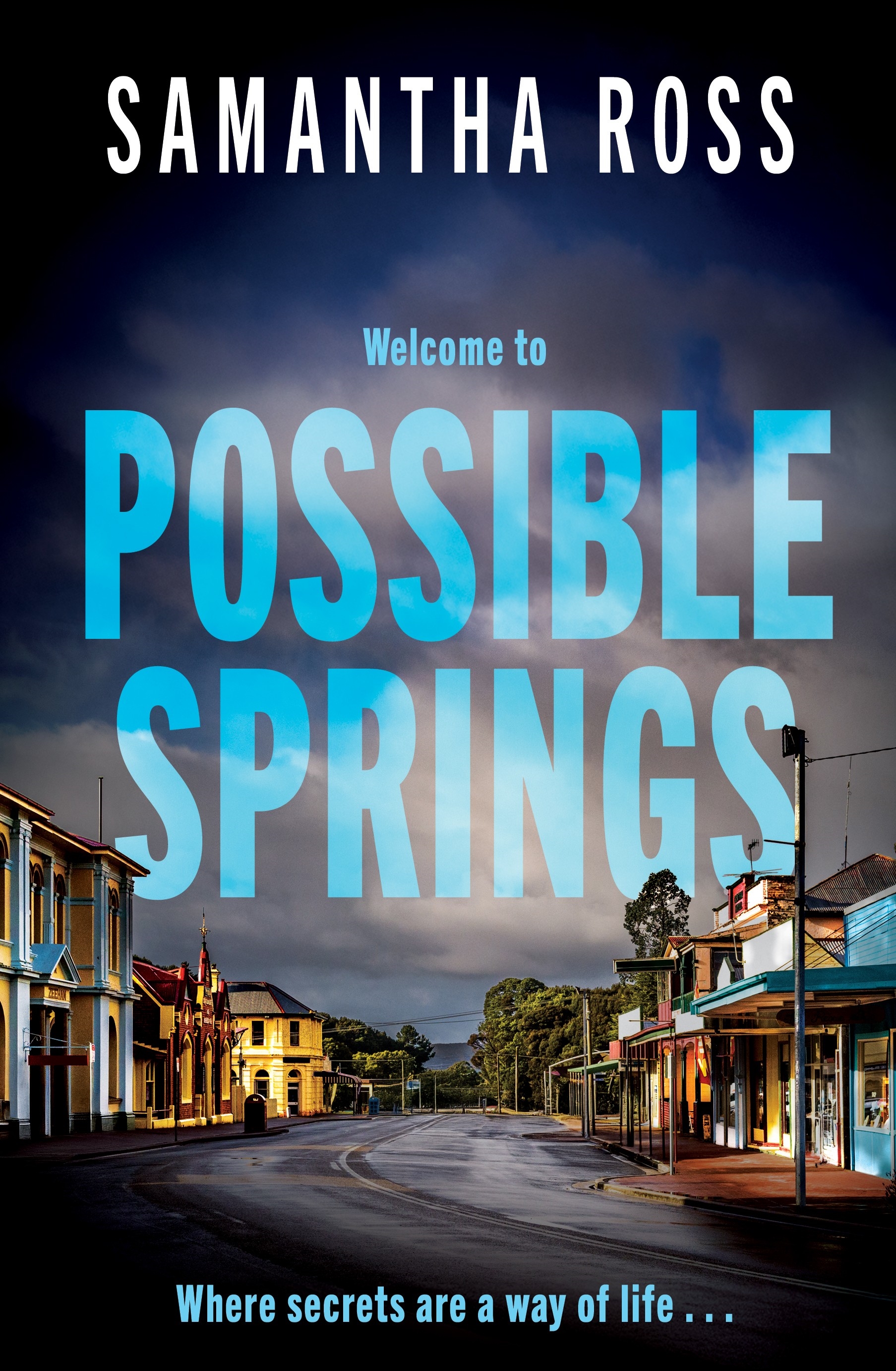
Possible Springs
Extract
February 1987
Break On Through to the Other Side
Jimny Adams should have died that day.
She whistled on her way to the river, making up the tune as she was mostly immune to music. She could take it or leave it. What she did take was five one-dollar coins from her father’s coin box. Since it was padlocked, she’d manoeuvred them through the slot with a butter knife.
Jimny did this regularly, causing her mum and dad to shoot her suspicious glances. They couldn’t accuse her, though, not with the shiny lock unharmed. Her parents couldn’t imagine how she managed it, because they lacked imagination. Already, at eleven-going-on-twelve, Jimny was wilier than they’d ever be. They would never know she’d just wolfed down a forbidden Snickers bar purchased with their money.
Jimny couldn’t understand their prohibition of snack food anyway. Why not do the things that felt good?
It never occurred to her that some of her parents’ anxiety was caused by their wayward little girl. Extra dental bills they could barely afford, reluctance to leave her alone with ride-on tractors, or with access to red metal paint for the barn, which she’d used to draw roses on her bedroom wall. It wasn’t that she meant harm – sometimes, she even felt guilty when her folks got upset. She was always sorry, but she was too distracted by the next fascinating thing to not do it again.
This would make her mother, Jude, purse her lips, roll her eyes to heaven, and admonish Jimny. ‘Away with the fairies again.’
Jimny was often grounded, which she understood she probably deserved. But home quarantine wasn’t a true inconvenience for her; she had no friends, so she couldn’t be denied spending time with them. Kids her own age never wanted to explore forbidden places with her, or write their name in fresh concrete, or put make-up on the farm animals. It was beyond Jimny how they were content to jump up and down over a rope for hours on end. Or why their idols were grown men in little shorts who kicked a ball around. And they looked at Jimny like she was the strange one.
A huge crow, the colour of ink, cawed from inside the bracken. It was a blazing hot day. The grassy farm fields looked bleached with thirst on her walk out of town. Now, on the dirt path, the forest trees around her were naked from malnourishment.
Such was the way of an Australian summer.
‘Stay away from the river, it’s dangerous on your own,’ Jude had warned before climbing into the car to collect supplies from a neighbouring shire. ‘You can visit your friends in town, if you like . . .’
Jude’s words had caused an awkward pause. She knew full well there was no one for Jimny to visit, but her gaze said she wished there were. Jimny could read her mother more easily than a Sweet Valley Twins book. How her friendless daughter added weight to Jude’s own fears of being an outcast.
Jimny, however, didn’t let herself fret. She kept busy by looking for things that took her fancy, and other kids couldn’t be trusted not to tell on her anyway.
Not far to the river now, and the sparkling water would make her forget that she hadn’t been invited to Cindy Errol’s birthday sleep over that weekend. Even though she told herself she didn’t care, Jimny’s face had burned when the invites were handed out. Every girl in the class had been asked, except her.
She fumed the same way when the kids at school made fun of her.
They were so dumb, with their boring taunts about a girl with a boy’s name. It was annoying that they were sometimes right. Her parents had chosen the name Jim, expecting another boy, and her dad had a stupid fondness for the Disney character Jiminy Cricket.
‘What’s skinny with red hair and falls down a dirty fireplace at Christmas? Chimney Adams!’ Sixteen-year-old Steven Newton liked to taunt her.
‘Yeah?’ Jimny retorted. ‘Well, at least my dad doesn’t sleep in the gutter outside the pub. And at least we have enough money for washing powder, so our whites don’t look washed in pee!’
Retorts like these sometimes made her aggressors cry, and Jimny had somehow ‘gone too far’ according to her parents.
‘It came out before I even knew it,’ she sobbed to her dad, Duncan. ‘And they started it. They say I like to argue, but that’s not true. I told them not to say stupid things, and then they expect me to be quiet. Doesn’t that make me right, Daddy?’
Duncan smoothed her hair and dried her tears. Jude was regularly too annoyed with Jimny to comfort her. ‘People can be right and wrong at the same time,’ he told her. ‘There’s music in you, honey, no mistake. We just have to find a way to show the world your special rhythm.’
Jimny appreciated that he tried to make her feel better. She also thought it ironic that her dad would use any reference to music. He’d tried to teach himself many an instrument, but each chord he played sounded like livestock dying.
Cicadas sang a barren echo over the bushland. Jimny heard the gurgling river interrupt them, letting her know she’d arrived where she’d been told not to go. But Jesus (her dad’s favourite word), it was stifling, and the thought of cool water was too tempting. Besides, Jimny felt she was old enough to do whatever she wanted. Hell, some kids her age mustered the cattle and broke in brumbies all on their own.
She didn’t let herself dwell on whatever punishment awaited her if she didn’t get home before her folks. The adventure was worth it.
Where the path veered, and a sandy bank could be found, Jimny stepped from the parched forest. At her favourite spot, the sun beat down and highlighted bronze river rocks and the sage shadows of water reeds. Overhanging gums and eucalyptus trees fringed a calm eddy.
Jimny loved it here. She dipped her feet in the water near the edge of the river, then lazed on the sand with a book. She never ventured further. The river’s edge might be calm enough, but like a travelator she’d once seen at an airport, a current pulled through the middle of the water. One time, it had snared her brother, Taylor, and almost swept him to the next town.
It was especially important to take heed of this today.
Her parents had whined that the rain this week hadn’t lasted long enough to revive the town’s thirsty crops, but it had certainly caused the river to swell. The water ran like a torrent.
This was where chance stepped in.
It began in town at a white weatherboard home adorned with lattice eaves.
The house had a huge porch with rocking chairs out the front, and an old, dozing German shepherd. A healthy garden, fed by bore water, boasted a half-acre emerald patch, bordered by fruit trees.
There was something of a fairytale about the house, except for the dog, Gruff, who everyone knew was downright sadistic. Nonetheless, butterflies, birds and flying foxes often completed the picture of rural serenity. Rabbits generally stayed away, though; like the townsfolk, they had become wary of the canine.
Gruff’s mistress, Maryanne Doble, picked ripe plums and apricots from her garden to sell at the Saturday farmers’ market. She also used their sweet flesh for her bakery pies. Her love for Gruff was protective, but she knew he had a tendency to attack, so she had built a picket fence around her garden higher than her dog could jump. Gruff would watch for her flickering silhouette to appear each day after she closed the bakery.
It was a still, stifling day, so there was no reason why a sudden gust would sweep the yard. Yet it did.
The breeze unhinged a fat purple plum, which hit the grass with a thud. A fluffy white rabbit, as cute as it was obvious, noted the fruit with consideration. His instinct warned him it was off limits, but his craving for a full belly proved too much. And so he leaped into the garden.
Gruff always slept with one eye open in case of this exact circumstance. Like a geyser, he sprang from the porch. The rabbit was already under the fence and bounding away before Gruff got within a metre of him. Maryanne might have made the fence high, but she never padlocked the gate. It was held shut simply with an arc-shaped latch. Unable to stop his lunge, Gruff slammed into the gate headfirst. The latch ricocheted.
And opened.
Exhilarated, Gruff galloped into a bloodthirsty adventure. Tracking the rabbit by scent, he set off towards the woods.
Old Georgina Tatleigh, or ‘Tattles’ as the town had christened her, was a fan of watching the world through her window, but she was no admirer of dogs. Not since Gruff had escaped once before and torn apart her succulents. Witnessing Gruff’s most recent break-out, she immediately rang Maryanne, indignant the dog might maul her garden again. The old lady resembled a favoured grandma, and her face held cookie-dough folds like that of a Shar Pei. But Tattles could show some bite, if she had a mind.
‘My militant missus,’ Mr Tatleigh liked to tease.
On the other side of town, Mark Cross was getting ready to pack a picnic. He’d only just begun seeing Maryanne – one of the few attractive and single ladies in town who had no children at the primary school where he taught. Gossip was a local pastime, and he didn’t need the other parents hinting at favouritism. Besides, he liked being seen as a paragon of good behaviour; it gave substance to a persona he feared the town would perceive as otherwise bland.
Maryanne usually closed the bakery at midday on Sundays. It was a few minutes past ten, giving Mark two hours to prepare a romantic lunch by the river. Perhaps it would lead to a bit of foreplay. Nothing too hot and heavy, though – he’d have to entice Maryanne home for a little afternoon delight. Tongues would wag if any local boys stumbled upon them in a state of undress.
Mark was pondering if a sprig of lavender in the picnic basket would be overdoing it when Maryanne rang.
‘Gruff got out. I have to go look for him. I’m not going to make it in time, sorry.’
Mark wanted to say her bloody mutt was a nuisance. Instead, he murmured to take all the time she needed.
‘I’d better drop Tattles some custard tarts too, once I find him. I’ll be with you soon as I can.’
With a sudden three or four spare hours looming, Mark decided to wander the river path anyway. It was good to exercise. His hair might be thinning, and his eyesight needed help from prescription glasses, but he was fit at thirty, with a physique that the ladies admired.
It was scorching by the river. Other than the recent rain, downpours had been sparse this year, turning the terrain into a baked province. The night before, a herd of teenage boys had been drinking beer on the sandbank, without much else to do. They preferred danger over monotony and swung from boughs overhanging the surging river, daring fate. A large branch had indeed snapped and sent one of the local boys into the gush. Thankfully, the dangerous water only swept him to the other side of the river, where it was a two-kilometre walk to meet up with his pals again in town.
They had cleared up their beer-bottle evidence, but left behind an unseen, lethally large branch beneath the water.
Gruff, on his blissful roam, had forgotten all about the rabbit. There were lizards to pounce on and wallabies to chase. A heady abundance of fear was perfume to his brute senses.
Jimny and the ferocious dog came face to face when he appeared on the bank where she sat with her book in hand.
Her fright was much more intoxicating than any small creature’s, and it woke Gruff’s hunting instinct once more. He dropped into a threatening crouch, inching his way towards the girl.
Jimny, familiar with Gruff’s reputation, slowly backed into the river, hoping the canine would not follow. She didn’t plan for a slippery rock to send her flailing into the water. And she didn’t know that hidden below the surface, the fallen branch created a fatal whirlpool, and it immediately siphoned Jimny into its spiky arms.
The splash Mark heard was too cumbersome for a leaping fish. He arrived on the bank in time to see a small hand disappear in the spray. An icy bloom of panic sluiced his sunburned skin.
Abandoning the chase, Gruff trotted over to his friend who sometimes gave him contraband lamingtons to ensure harmony. His tail drooped, though, when Mark didn’t stop to rub his belly. Instead, the teacher bolted for the water.
Mark didn’t realise he was cursing as the current whiplashed his balance. The rip, deadly and demanding, gave way to a powerful suction. But he couldn’t allow a child to drown.
Adrenaline propelled him into the vortex.
Again and again, he cast his fingers into the roaring foam. Gulping for air, he was seized by a horrific realisation; the child had been vacuumed too far down.
He was halfway to drowning when he gave up all hope. Yet at the moment Mark decided to save himself, he felt a silky tendril brush his foot. He thrust his arm deeper beneath the water and wrapped his hand around a ponytail.
Jimny was beyond fear. Her swimmers were snagged on the underwater branch, keeping her imprisoned until there was no choice but to breathe. At first, this caused hysteria. Then a soothing calm took over, where she was weightless with peace. The luminous light that beckoned was beautiful. And it was okay, this was the way it was supposed to be. Jimny felt she was being called to a place where she could do exactly as she pleased.
The stark fact was, Jimny Adams had very little music in her soul. Yet fate and circumstance decided not to end her story on that note.
She didn’t feel her hair being yanked.
Mark was frantic as he pumped the little girl’s chest. At school, he’d always found Jimny Adams trying and mouthy, but with enough intelligence to back up her shrewd nitpicking in his class. Mark would forgive her anything right now, though. He needed her to fight.
Relief doused him when she spewed a fountain of water. But it didn’t mean she was in the clear – there might still be liquid in her lungs. Not to mention the risk of brain damage. Oh, help, what if he hadn’t got to her in time?
He scooped her up and ran. Thankfully Gruff had taken off to look for more adventure, and wouldn’t get under his feet. There wasn’t a clear-cut trail on this side of the river, and the thicket tore his skin. Yet he felt nothing but desperation to cover the kilometres and reach the town hospital.
On the outskirts of Main Street, he began waning. Like a marathon runner nearing the finish, Mark limped towards the town centre with Jimny in his arms. Russ Salter, a bear of a man with impressive strength, took in the tableau, snatched Jimny like a baton from the lagging teacher and headed for the emergency room.
Among a flurry of professional excitement, the doctors and nurses brought Jimny back to life after three attempts. Fortune was smiling down: the river had been cold enough to slow her vitals, and her rescue timely enough to resuscitate them.
Mark stayed by the little girl’s side. Partly from concern, partly because he didn’t want to miss out on the heroic accolades that were sure to come. Saving a life would earn him ‘special favours’ from Maryanne for sure.
It had been a traumatic day, and Mark could feel fatigue taking hold. From the waiting room, a Phil Collins tune seeped throughout the hospital. Its lulling melody made him slump, and his mind began to wander. How fortunate the timing of Jimny’s accident had been. If things had gone as planned, he wouldn’t have been anywhere near the river so early in the day. Perhaps it was meant to be, Maryanne cancelling their date. He’d forgotten to clean the shower after his housekeeper had refused to do it – she said it smelled like pee. It wouldn’t do for Maryanne to sniff the same thing.
Jimny’s fern-coloured eyes opened and gazed at him, direct.
‘Then stop pissing in it,’ she said.
Possible Springs Samantha Ross
A mesmerising fiction debut - that’s part coming-of-age novel and part mystery - set in a small Australian town.
Buy now