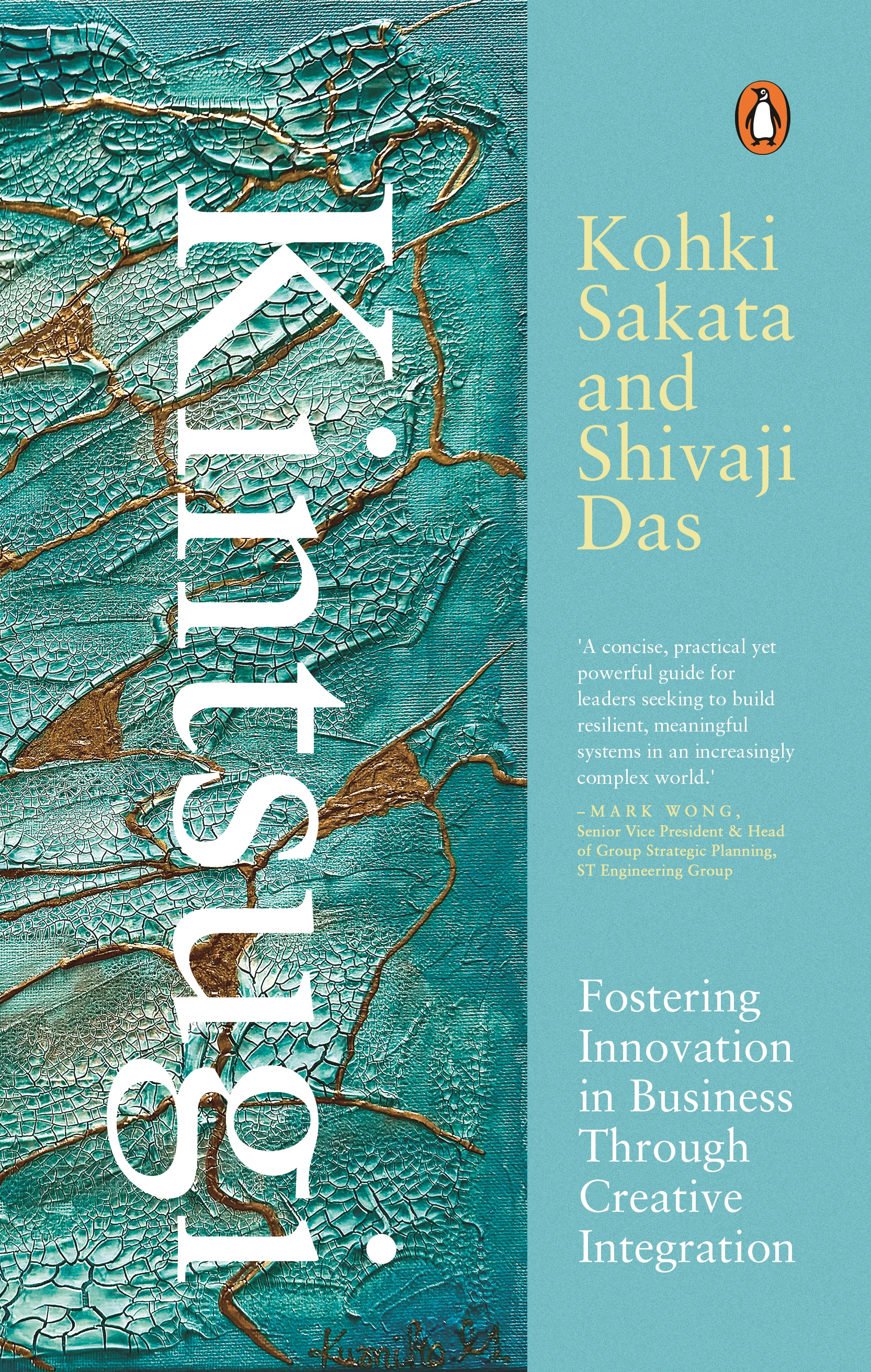
Transforming businesses and communities through kintsugi—innovation, integration, and resilience.
In an era obsessed with disruption, we are often told that progress requires tearing down the old to make way for the new. But what if the most powerful form of innovation is not destruction, but repair?
Kintsugi: Fostering Innovation in Business through Creative Integration introduces a new way of thinking about growth, strategy, and transformation, inspired by the Japanese art of repairing broken pottery with gold. In kintsugi, the crack is not hidden; it is highlighted, turning fracture into strength and beauty. This book argues that the same philosophy is increasingly shaping the most successful innovations of the twenty-first century.
Across Asia and beyond, many breakthrough companies are not replacing existing systems but creatively integrating them. Ride-hailing platforms like Grab and Gojek have connected informal drivers, small merchants, and digital payments into everyday infrastructure. China's Taobao Villages have revitalized rural economies by linking traditional communities to global e-commerce. Companies such as Vinhomes, CARSOME, Tata 1mg, and Heng Hiap Industries have rebuilt trust, healthcare access, and circular supply chains by joining fragmented ecosystems rather than discarding them.
Drawing on rich case studies and practical insights from business strategy and regional development, the authors present 'creative integration' as a new paradigm for innovation. In a world defined by demographic change, climate pressure, and technological disruption, the challenge is no longer simply to invent something new, but to reconnect what has been separated.
Kintsugi offers leaders a powerful framework for doing exactly that: discovering hidden value in legacy systems, designing stronger connections between digital and physical worlds, and building resilient ecosystems rooted in trust and continuity.
The future will not belong to those who destroy the past most quickly. It will belong to those who know how to mend it.
Kohki Sakata
Kohki Sakata is a Partner at IGPI Group and CEO of IGPI Singapore, a strategy consulting and investment firm that works with companies across Asia to drive transformation, innovation, and international expansion. Over the course of his career, he has advised and led projects in a wide range of industries including mobility, healthcare, telecommunications, retail, logistics, and digital platforms.
Sakata began his career at Capgemini and Coca-Cola before joining Revamp Corporation, where he worked on corporate revitalization and global growth strategies. At IGPI, he has led numerous cross-border initiatives across Asia and Europe, helping organizations rethink strategy, redesign business models, and navigate structural shifts in rapidly changing markets.
His work focuses particularly on how companies can evolve by integrating legacy strengths with new technologies and ecosystems rather than relying solely on disruptive change. This perspective has shaped much of his writing and advisory work, especially in the context of Asian economies where historical institutions, local networks, and emerging digital platforms coexist.
Sakata is also a prolific author on strategy, innovation, and organizational thinking. His previous books include Architectural Thinking, Agile Work Techniques, Digital Frontier, Functional Expansion, Managerial Thinking Techniques to Avoid the Pitfalls of Management, and Designing Strategy. His works have been widely read by business leaders and managers across Japan and Asia.
He holds a bachelor's degree from Waseda University and an MBA from IE Business School.
Shivaji Das
Shivaji Das is the author of The Visible Invisibles (Penguin Random House SEA, 2022), Rebels, Traitors, Peacemakers (Penguin Random House SEA, 2024), The Great Lockdown (Wiley-USA, 2021), the Amazon #1 Bestseller The Other Shangri-La: Journeys through the Sino-Tibetan frontier in Sichuan (Konark Books, 2020), etc. He was the first prize winner for Time magazine's Sub-Continental Drift Essay contest and shortlisted for Fair Australia Prize for Short Stories.
Shivaji has been actively involved in migrant issues and is the conceptualizer and organizer for the acclaimed Migrant Worker and Refugee Poetry Contests in Singapore, Malaysia and Kenya and is the founder and director of the Global Migrant Festival. Shivaji's work and his interviews have been featured on TIME, BBC, CNBC, The Economist, Travel Radio Australia, Around the World TV, etc. Shivaji's writings on China have been published avenues such as South China Morning Post, Think China, The Diplomat, Jakarta Post, etc.
Shivaji is a graduate from IIT Delhi and has an MBA from IIM Calcutta. He currently works as the Managing Director of IGPI, Singapore, prior to which he was the Managing Director – APAC for Frost & Sullivan. Shivaji is a Singapore citizen. https://www.shivajidas.com
Related titles
Our top books, exclusive content and competitions. Straight to your inbox.
Thank you! Please check your inbox and confirm your email address to finish signing up.