
- Published: 26 February 2018
- ISBN: 9780241248799
- Imprint: Penguin General UK
- Format: Paperback
- Pages: 272
- RRP: $24.99
Anything is Possible
Extract
This morning Tommy drove slowly to the town of Carlisle for errands; it was a sunny Saturday in May, and his wife’s eighty-second birthday was just a few days away. All around him were open fields; the corn newly planted, and the soybeans too. A number of fields were still brown as they got plowed under for their planting, but mostly there was the high blue sky, with a few white clouds scattered near the horizon. He drove past the sign that led to the Barton home; it still said SEWING AND ALTERATIONS, even though the woman, Lydia Barton, who did the sewing and alterations had died many years ago. The Barton family had been outcasts, even in a town like Amgash, their extreme poverty and strangeness making this so. The oldest child, a man named Pete, lived alone there now, the middle child was a few towns away, and the youngest, Lucy Barton, had fled many years ago, where she ended up living in New York City. Tommy had spent time thinking of Lucy. All those years she had stayed after school, alone in a classroom, from fourth grade right up to her senior year in high school; it had taken her a few years to even look him in the eye.
But now Tommy was driving past the area where his farm had been – these days it was all fields, not a sign of the farm was left -- and he thought, as he often thought, about his life back then. It had been a good life; but he did not regret the things that happened. It was not Tommy’s nature to regret things, and on the night of the fire – in the midst of his galloping fear -- he understood all that mattered in this world was his wife and his children, and he thought people lived their whole lives not knowing this as sharply and constantly as he did. Privately, he thought of the fire as a sign from God to keep this gift tightly to him. Private, because he did not want to be thought of as a man who made up excuses for a tragedy; and he did not trust anyone -- even his dearly beloved wife – to think that he had done this. But he had felt that night, while his wife kept the children over by the road – he had rushed them from the house when he saw the barn was on fire – as he watched the enormous flames flying into the nighttime sky, and then heard the terrible screaming sounds of the cows as they died, he had felt many things, but it was just as the roof of his house crashed in, fell into the house itself, right into their bedrooms and the living room below with all the photos of the children and his parents, as he saw this happen, he had felt – undeniably – what he could only think was the presence of God, and he understood why angels had always been portrayed as having wings, because there had been a sensation of that – of a rushing sound, or not even a sound, and then it was as though God, who had no face, but was God, pressed up against him and conveyed to him without words – so briefly, so fleetingly – some message, that Tommy understood to be: It’s all right, Tommy. And then Tommy had understood that it was all right. It was beyond his understanding, but it was all right. And it had been. Arguably, it had been more than all right, for he often thought his children had become more compassionate as a result of having to go to school with kids who were poor, and not from homes like the one they had first known. He had felt the presence of God since, at times, as though a golden color was pressed up against him, but he never again felt visited by God as he had felt that night, and he knew too well what people would make of it, and this is why he would keep it to himself until his dying day – the sign from God.
Still, on a spring morning as this one was, the smell of the soil brought back to him the smells of the cows, the moisture of their nostrils, the warmth of their bellies, and his barns – he had had two barns – and he let his mind roll over pieces of scenes that came to him. Perhaps because he had just passed the Barton place he thought of the man, Ken Barton, who had been the father of those poor, sad children, and who had worked on and off for Tommy, and then he thought – as he more often did – of Lucy, who had left for college and then ended up in New York City. She had become a writer.
Lucy Barton.
Driving, Tommy shook his head just slightly. Tommy knew many things as a result of being the janitor in that school more than thirty years; he knew of girls’ pregnancies and drunken mothers and cheating spouses, for he overheard these things talked about by the students in their small huddles by the bathrooms, or near the cafeteria; in many ways he was invisible, he understood that. But Lucy Barton had troubled him the most. She and her sister, Vicky, and her brother Pete, had been viciously scorned by the other kids, and by some of the teachers too. Yet, because Lucy stayed after school so often for so many years, he felt – though she very seldom spoke – that he knew her the best. One time when she in the fourth grade, it was his first year working there, he had opened the door to a classroom and found her lying on three chairs pushed together, over near the radiators, her coat as a blanket, fast asleep. He had stared at her, watching her chest move just slightly up and down, seen the dark circles beneath her eyes, her eyelashes spread like tiny twinkling stars, for her eyelids had been moist as though she had been weeping before she slept, and then he backed out slowly, quietly as he could; it had felt almost unseemly to come upon her like that.
But one time – he remembered this now – she must have been in junior high school, and he walked into the classroom and she was drawing on the blackboard with chalk. She stopped as soon as he stepped inside the room. “You go ahead,” he said. On the board was a drawing of a vine with many small leaves. Lucy had moved away from the black board, and then she suddenly spoke to him. “I broke the chalk,” she said. Tommy told her that was fine. “I did it on purpose,” she said then, and there was a tiny glint of a smile, before she looked away. “On purpose?” he asked, and she had nodded, again with the tiny smile. So he had gone and picked up a piece of chalk, a full stick of it, and he snapped it in half and winked at her. In his memory she had almost giggled. “You drew that?” he asked, pointing to the vine with the small leaves. And she shrugged then and turned away. But usually, she was just sitting at a desk and reading, or doing her homework, he could see that she was doing that.
He pulled up to a stop sign now, and said the words aloud to himself quietly, “Lucy, Lucy, Lucy B. Where did you go to, how did you flee?”
He knew how. In the spring of her senior year, he had seen her in the hallway after school, and she had said to him, so suddenly open-faced, her eyes big, “Mr. Guptill, I’m going to college!” And he had said, “Oh, Lucy. That’s wonderful.” She had thrown her arms around him; she had not let go, and so he hugged her back. He always remembered that hug, because she had been so thin; he could feel her bones and her small breasts, and because he wondered later how much – how little – that girl had ever been hugged.
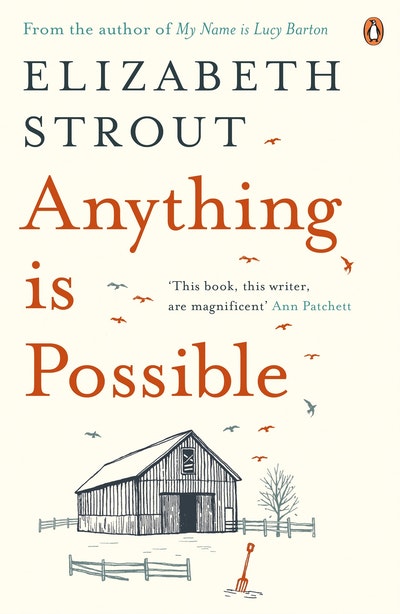
Anything is Possible Elizabeth Strout
A stunning novel by the No. 1 New York Times bestselling, Times Top 10 bestseller and Man Booker long-listed author of Olive Kitteridge and My Name is Lucy Barton
Buy now