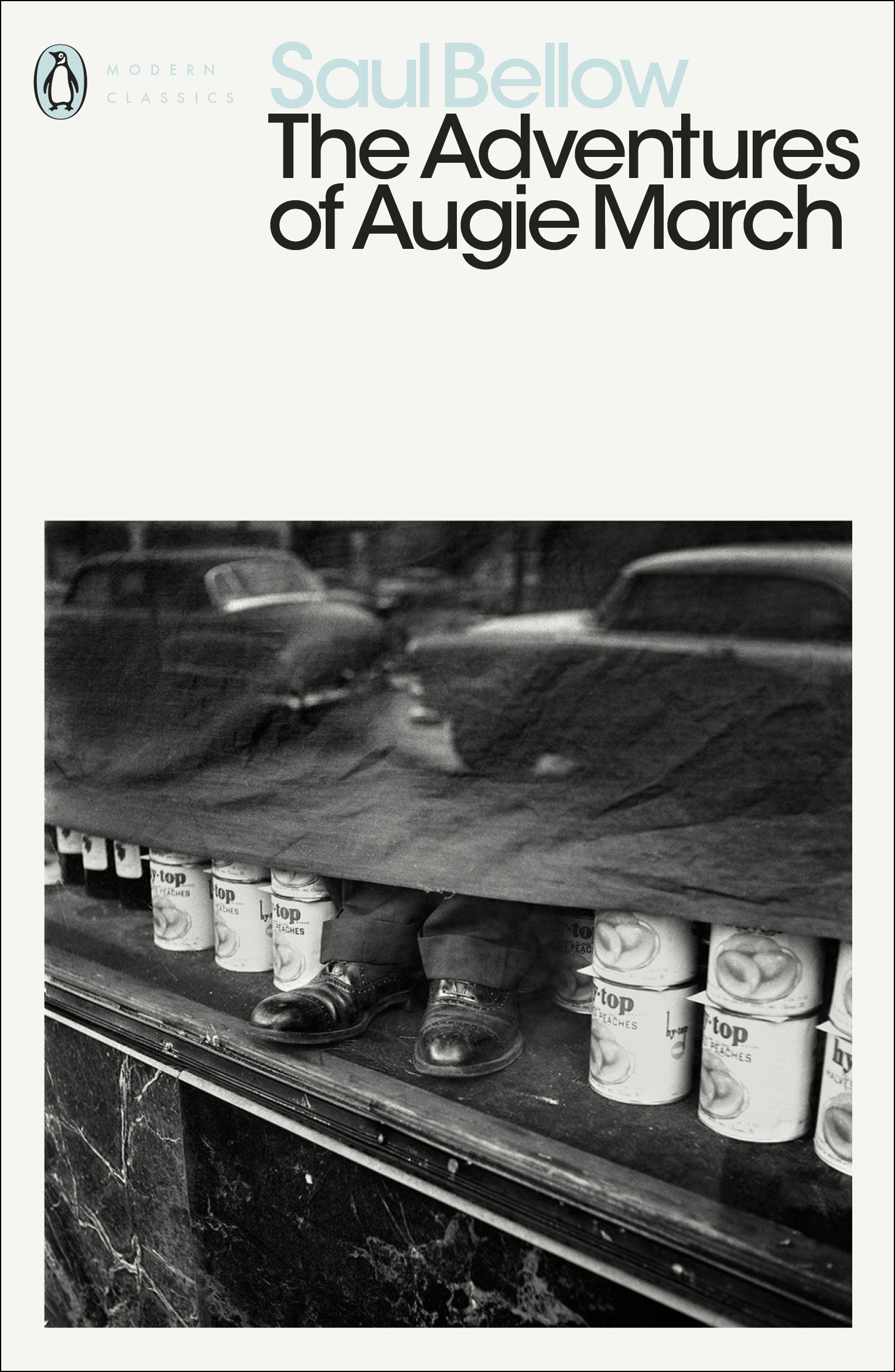
The Adventures of Augie March

Author: Saul Bellow

Reading Notes

Reading Notes

Book Club Notes for The Adventures of Augie March by Saul Bellow

Book Summary

Saul Bellow's The Adventures of Augie March burst on the postwar literary scene with the exuberance of a great American author finding his true voice. The most freewheeling of Bellow's heroes, Augie paints a fresh, gritty, comic view of the American landscape and poses anew the perennial questions: How do you reconcile freedom and love? How do you simultaneously find liberty and home in a chaotic world?

Bellow was already a well-known author when he began writing his third novel, but his early works, Dangling Man and The Victim, are very different books, written in a constrained, naturalistic form that he ultimately rejected as too limiting. Their central characters, introspective intellectuals trapped in claustrophobic circumstances, are reminiscent of Kafka's narrators. 'I was afraid to let myself go,' Bellow says of these works. He discarded the drafts of two additional novels because he felt they, too, were too bleak. Tired of the 'solemnity of complaint,' the plaintive tone he heard in the novels of his contemporaries and in his own first books, Bellow turned to his boyhood home in Chicago for inspiration.

The change proved immensely liberating and gave rise to the colourful cast of Augie March: Grandma Lausch, Einhorn, Five Properties, Dingbat, and many others, all of whom were rooted in the Humboldt Park neighbourhood of Bellow's youth. Augie, a poor but spirited boy growing up in Chicago during the Depression, leaves his mother and disabled younger brother to find his way in the world. He enters a wild succession of occupations- dog groomer, saddle soap salesman, smuggler, shoplifter, boxing coach-guided by an equally fantastic array of mentors. Each of these 'recruiters' attempts to determine Augie's lot in life, but whenever he is at risk of being taken by a person or profession, he slips away to a new misadventure, equal parts joiner and escapist. Not until his affair with Thea Fenchel does Augie begin to realize that love and independence are irreconcilable.

In one sense Augie is a characteristic Bellow hero, a young man with an ironic sense of the world, wary of taking direct action but certain that he belongs to a greater destiny. Like Bellow's other central characters, he is intent on finding a 'good enough fate' eager to write his own part on life's stage yet stubbornly resistant to the limits imposed by any scripted role. But he is also dramatically different from the brooding thinkers of Bellow's early works. Augie is playful, subversive, adventurous, and ever optimistic. He is a new American Adam, innocently poised for a future full of promise in a land full of possibilities. No profession, no lover, no commitment can capture him. He risks his job as a book thief because he can't resist the desire to keep and read the books he has stolen. Although this very adaptability, this lack of firm obligations makes him hard to characterize or define, his first-person narrative conveys a compelling vision of American freedom, a fresh spirit of irresistible charm.

While Augie's character remains protean, the world he inhabits is painted with magnificent detail and texture. Infused with the vivid, hyperbolic Yiddish of his childhood, Bellow's narrative revels in the melodramatic people and language of 1920s Chicago. As Bellow said:

'The most ordinary Yiddish conversation is full of the grandest historical, mythological, and religious allusions. The Creation, the fall, the flood, Egypt, Alexander, Titus, Napoleon, the Rothschilds, the Sages, and the Laws may get into the discussion of an egg, a clothes-line, or a pair of pants.'

The language of Augie March is likewise rife with heroic allusions, casting a mythic glow on Augie's smallest move. Augie's thoughts about his job as a labor organizer invoke John the Baptist, Stonewall Jackson, the Tower of Babel, and Ghandi's India in quick succession. Yet the extravagant metaphors sound uncalculated, falling as easily on the ear as a street-corner conversation. 'The great pleasure of the book was that it came easily,' Bellow said in an interview. 'All I had to do was be there with buckets to catch it. That's why the form is loose.'

Praise for Bellow's ebullient new style was enthusiastic, if not unanimous, and he won the National Book Award in 1953. Augie March was compared to Ulysses and described as 'a howlingly American book.' Supporters and critics alike recognized in him a powerful voice, a vision of America that could not be ignored. The book brought 'a new sense of laughter,' wrote Alfred Kazin. 'In Augie, Bellow . . . discovered himself equal to the excitement of the American experience, he shook himself all over and let himself go.'

Ultimately Augie's vision finds a tamer, more mature expression in Herzog, Bellow's masterwork. But Augie March holds a unique place for its rev- olutionary joy and exuberance. This rollicking tale of modern-day heroism is not only a portrait of determination and survival, but also a keenly observed drama of one man's 'refusal to lead a disappointed life.'  

About the author

Praised for his vision, his ear for detail, his humor, and the masterful artistry of his prose, Saul Bellow was born of Russian Jewish parents in Lachine, Quebec in 1915, and was raised in Chicago. He received his Bachelor's degree from Northwestern University in 1937, with honors in sociology and anthropology, and did graduate work at the University of Wisconsin. During the Second World War he served in the Merchant Marines.

His first two novels, Dangling Man (1944) and The Victim (1947) are penetrating, Kafka-like psychological studies. In 1948 he was awarded a Guggenheim Fellowship and spent two years in Paris and travelling in Europe, where he began his picaresque novel The Adventures of Augie March. Augie March went on to win the National Book Award for fiction in 1954. His later books of fiction include Seize the Day (1956); Henderson the Rain King (1959); Mosby's Memoirs and Other Stories (1968); Mr. Sammler's Planet (1970); Humboldt's Gift (1975), which won the Pulitzer Prize; The Dean's December (1982); More Die of Heartbreak (1987); Theft (1988); The Bellarosa Connection (1989); The Actual (1996); and, most recently, Ravelstein (2000). Bellow has also produced a prolific amount of non-fiction, collected in To Jerusalem and Back, a personal and literary record of his sojourn in Israel during several months in 1975, and It All Adds Up, a collection of memoirs and essays.

Bellow's many awards include the International Literary Prize for Herzog, for which he became the first American to receive the prize; the Croix de Chevalier des Arts et Lettres, the highest literary distinction awarded by France to non-citizens; the B'nai B'rith Jewish Heritage Award for 'excellence in Jewish Literature'; and America's Democratic Legacy Award of the Anti-Defamation League of B'nai B'rith, the first time this award has been made to a literary personage. In 1976 Bellow was awarded the Nobel Prize for Literature 'for the human understanding and subtle analysis of contemporary culture that are combined in his work.'

Book Club Discussion Questions 

  1. 'A man's character is his fate,' says Augie, but his own character is elusive. As Robert Penn Warren wrote at the time of the novel's publication, 'it is hard to give substance to a man who has no commitments.' What are Augie's commitments? What defines his character?
  2. Augie repeatedly invokes mythic and historic figures to describe his mentors. Grandma Lausch is like a pharaoh, a Caesar, a Machiavelli. William Einhorn is Croesus or the Sun King at Versailles. Thea Fenchel evokes Queen Elizabeth and Helen of Troy. Simon is Napoleon. Why are the lives of small-time operators portrayed in such grandiose terms?
  3. The book's title invites comparison to another quintessentially American novel, The Adventures of Huckleberry Finn. Each work features a poor boy who leaves his Midwestern home town to undertake a liberating pilgrimage. How are Augie and Huck alike in their outlook and dreams? How is Mark Twain's America different from Bellow's?
  4. Getting involved with Thea Fenchel and her eagle is a turning point for Augie. After leading a life of escape from others, he is abandoned for the first time. What happens to Augie's sense of reality when Thea leaves him?
  5. Augie's adventures initially resemble a picaresque novel like Tom Jones, in which a clever, likable rogue, after a series of misadventures, eventually comes to repent the error of his ways. Does Augie ever achieve such a repentance? What prevents him? What does Bellow's subversion of this genre suggest about his view of the human condition?
  6. Near the end of the novel, Augie makes an important commitment when he marries Stella. Why, after a life unbound by any one job or person, does he make this decision? How does Stella influence him?
  7. Grandma Lausch shows Augie that 'wit and discontent' can go together and teaches him to lie- not because he needs to, but simply for the joy of the contest. How does this gaming spirit, this joy in subversion inform his later temperament and professions?
  8. What forces interfere with Augie's dream of happiness on the 'axial lines of life'? Does Bellow allow the reader to believe in the fulfillment of Augie's wish to become a teacher? Why, among all his professions, is teaching the one that captures his imagination?
  9. In one sense Augie is obsessed with learning, weaned on the Encyclopedia Americana and compelled to read the books he steals rather than selling them. What drives Augie's intellectual hunger? Is knowledge an end in itself for him, or does he put it to practical use?

  10. Bellow's prose in Augie March has been described as 'a child's wildest ice-cream sundae dream.' Nouns and verbs are strung six or eight in a row, coupled with abundant similes and historical allusions. Discuss the impact of Bellow's language in Augie March on character, landscape, and tempo in the novel.    


Also by Saul Bellow

Book Cover:  Saul Bellow: Letters
By Saul Bellow & Benjamin Taylor

'Magnificent . . . The man is all here in this book, in this stunning, almost baffling plenitude.  Bellow's letters are one of Bellow's greatest books.' – The New York Times Book Reviews

'Magnificent . . . The man is all here in this book, in this stunning, almost baffling plenitude.  Bellow's letters are one of Bellow's greatest books.' – The New York Times Book Reviews

Published: 21/03/2012
Format: Paperback
ISBN: 9780143120469
RRP: $24.95
Book Cover:  Him With His Foot in His Mouth: Mini Modern Classics
By Saul Bellow

Vital, exuberant, streetwise and philosophizing, Nobel Prize winner Saul Bellow is one of the undisputed masters of American prose. In this inspired novella an ageing man writes an apology for his rudeness to a librarian thirty-five years earlier, unleashing a dazzling, rancorous comic riff on growing old, regret, rudeness, smoking and 'the world's grandeur'.

Vital, exuberant, streetwise and philosophizing, Nobel Prize winner Saul Bellow is one of the undisputed masters of American prose. In this inspired novella an ageing man writes an apology for his rudeness...

Published: 17/03/2011
Format: Paperback
ISBN: 9780141195742
RRP: $5.00
Book Cover: The Actual
By Saul Bellow
Harry Trellman, an ageing, astute Chicago businessman, has never really belonged anywhere. His human attachments, life everything else in his life, are singular and irregular. But Harry's observational talents have not gone unnoticed by billionaire Sigmund Adletsky, who retains him as his advisor. Soon the old man discoveres behind Harry's stoic mask an intense forty-year-old passion – and the...
Harry Trellman, an ageing, astute Chicago businessman, has never really belonged anywhere. His human attachments, life everything else in his life, are singular and irregular. But Harry's observational...
Published: 18/07/2008
Format: Paperback
ISBN: 9780141188843
RRP: $22.95
Book Cover: The Victim
By Saul Bellow
While his wife is away visiting her mother, Leventhal feels lost and alone. One evening, seeking relief from the New York heat wave, he is accosted in a park near his apartment by a seedy-looking drunk. Levelthal faintly recognizes the hostile man as someone he once met in the past. The man, however, claims Leventhal ruined his life.

Can this be true? Did he cause harm to this man? Unable to shake...

While his wife is away visiting her mother, Leventhal feels lost and alone. One evening, seeking relief from the New York heat wave, he is accosted in a park near his apartment by a seedy-looking drunk...
Published: 11/03/2008
Format: Paperback
ISBN: 9780141188836
RRP: $24.95
Book Cover: The Dean's December
By Saul Bellow
Albert Corde, dean of a Chicago college, is unprepared for the violent response to his scathing articles on city corruption and his involvement in the trial of two black people charged with killing a white student. He finds himself accused of being a civic-minded fool and a racist. Journeying to Bucharest, where his mother-in-law lies dying, Corde compares the corruption and inhumanity of Communism...
Albert Corde, dean of a Chicago college, is unprepared for the violent response to his scathing articles on city corruption and his involvement in the trial of two black people charged with killing a white...
Published: 11/03/2008
Format: Paperback
ISBN: 9780141188867
RRP: $24.95
Book Cover:  To Jerusalem and Back: A Personal Account
By Saul Bellow
In the mid-1970s, Saul Bellow visited Israel and To Jerusalem and Back is his account of his time there. Immersing himself in its landscape and culture, he records the opinions, passions and dreams of Israelis of varying viewpoints – from Prime Minister Rabin, novelist Amos Oz and the editor of an Arab-language newspaper to a kibbutznik escaped from the Warsaw ghetto and the barber at Bellow's...
In the mid-1970s, Saul Bellow visited Israel and To Jerusalem and Back is his account of his time there. Immersing himself in its landscape and culture, he records the opinions, passions and dreams of...
Published: 11/03/2008
Format: Paperback
ISBN: 9780141188874
RRP: $24.95
Book Cover:  Ravelstein
By Saul Bellow
Abe Ravelstein – ferocious intellectual, bestselling author, confident of presidents and prime ministers and possessor of tastes that would bankrupt a king – is celebrating his success in Paris. He and his friend Chick trawl the Parisian streets in search of haute couture, fine foods and fresh arguments. But Ravelstein is dying and, in challenging Chick to record his life, he sets in motion...
Abe Ravelstein – ferocious intellectual, bestselling author, confident of presidents and prime ministers and possessor of tastes that would bankrupt a king – is celebrating his success in Paris...
Published: 11/03/2008
Format: Paperback
ISBN: 9780141188850
RRP: $24.95
Book Cover:  It All Adds Up
By Saul Bellow
Saul Bellow's fiction, honoured by a Nobel Prize and a Pulitzer, among other awards, has made him a literary giant. Now the man himself and a lifetime of his insightful views on a range of topics spring off the page in this, his first non-fiction collection, which encompasses articles, lectures, essays, travel pieces, and an 'Autobiography of Ideas'. It All Adds Up is a fascinating journey through...
Saul Bellow's fiction, honoured by a Nobel Prize and a Pulitzer, among other awards, has made him a literary giant. Now the man himself and a lifetime of his insightful views on a range of topics spring...
Published: 04/02/2008
Format: Paperback
ISBN: 9780141188829
RRP: $24.95
Published:27/06/2001
Format:Paperback, 560 pages
RRP:$29.95
ISBN-13:9780141184869
ISBN-10:0141184868
Publisher:Penguin UK

News

{ view all }
21 May 2012
2012 Australian Book Industry Awards (ABIAs) - winners

The Australian Book Industry Awards were held in Sydney on Friday night. It was a great night for Penguin with our books taking the top honors in four book categories including the prestigious Book of the Year. Congratulations also to Peg McColl, Kate McCormack and the rights team who won the International (Rights) Award for the second year running for Paul French's book Midnight in Peking. United Book Distributors were again named Distributor of the Year.

Illustrated Book of the Year

Social Feed

{ }

Penguin TV

{ }

Pictures

{ }