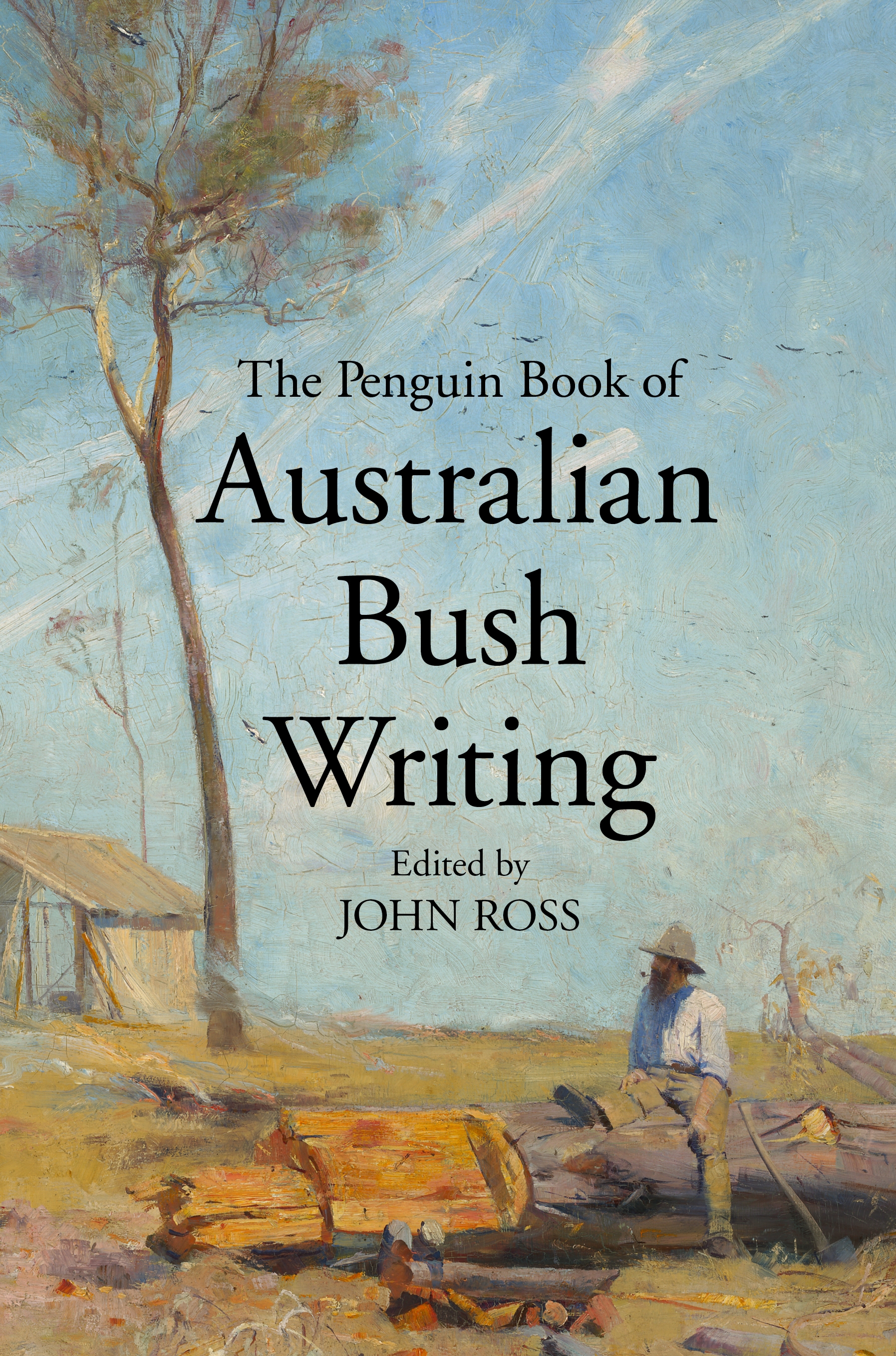
The Penguin Book of Australian Bush Writing

Author: John Ross

Extract

Extract

Introduction

The Australian bush – sometimes referred to as 'the great emptiness' – has been a rich topic for generations of Australian writers. Literary evocations of the land and its people – of struggle and humour, of hardship and hard labour, of make-do and mateship – have done much to foster our understanding and love of country.

As Australians we carry a certain vague longing for the bush, a feeling often inculcated by story and song rather than deep experience.

Australians overseas can become genuinely emotional over a whiff of gum leaves, and expatriates in 'cities pent' can be transported by a glimpse of country on the ABC news. And all of us are moved by words written – yesterday or long ago – about the experiences of the bush.

A recent study of national characteristics found that there are geographic triggers of patriotism from country to country – for Russians it is the vast sweep of the steppes from Moscow to Siberia, for Italians the crowded life of the village square, for the Scots the mountain crags and glens of the highlands. For Australians it is simply the bush, that ill-defined territory more country than town.

It is in places of dry farmlands and big mobs of cattle and sheep; it is in parched watercourses and lazy rivers. These were the places of bush itinerants – shearers, drovers, workers, battlers – that gave rise to the Australian qualities of strength, stoicism and the fair go that are now mostly seen on sporting grounds and battlefields.

The bush can be far away in the backblocks of all of the states, or just down the road, only a short journey from any of our capital cities.

Picture big gum trees and low hills of pasture, moving through shades of grey to green with the seasons, with bones of rocks and boulders protruding here and there. There are the skeletal remnants and shards of fallen timber, and, in the haze of the blue mountain or the forest in the distance, there is the natural and original vitality of the land.

There are other country scenarios, of course – rainforest and plain, snowfield and coastline, and the great and still-mysterious inland. The desert as the last frontier holds a singular magic, as the pall of nothing but sand and scrub for thousands of kilometres can be suddenly arrested by the emergence of the thrall of escarpments, gorges and hidden valleys, all laid down by time and the workings of nature on ancient tablelands.

The Penguin Book of Australian Bush Writing will transport you into those inland depths. You will be in the company of great characters and surprising dramas, and fall under the spell of many Australian writers. The stories range through time and place, but are always somewhere in the heartland.

Many writers demand their inclusion, and we may be allowed to bask a little in the contributions of the early giants Henry Lawson and

A.B. 'Banjo' Paterson. Lawson's reportage seems so easy and is so rich in atmosphere and variety. He gives us a brisk lesson on itinerant life in 'The Romance of the swag', which contrasts with the sombre note of 'In a Wet season', when he takes an agonisingly slow train journey through sodden country. And Paterson's masterly observations bring all the greatness of our pastoral past into focus with his reflections on 'The Trouble with Merinos'.

Not far behind Lawson and Paterson is Edward S. Sorenson, who had a wry look at Bushman Junior in the analogously titled story from his book Life in the Australian Backblocks.

There is danger and drama in many journeys across the vastness of the land, as latter-day explorers attempt some pretty hard assignments. That most intrepid solo walker G.E. 'Chinese' Morrison goes for a solitary ramble from Darwin to Melbourne in 'A Transcontinental Ramble'. C.T. Madigan seeks to conquer the last unknown inland as he leads his team into the simpson Desert in 'Crossing the Dead Heart'. Geoffrey Dutton's father is determined to be the first across the continent by motor car in 'Across Australia by Car'. Alan Marshall travels in a horse-drawn caravan, while Jonathan Green and family make it around Australia in eighty days, and Green writes his newspaper column as well, despite getting trapped in Borroloola.

As faraway places go, Keith Willey finds that Borroloola is at the end of the line, but there are other people looking around elsewhere. D'Arcy Niland explores the first inland city in 'Bathurst', and Alan Frost travels the cane fields of the tropical north. And the drama is immediate in two classic newspaper features: in 'Cheating the Flames of Death', Gary Hughes fights for survival in the Black Saturday bushfires, and in 'An Angel in the Queensland Floods', Tony Wright relates an all-night struggle for life in the Grantham flood surge.

And among the other adventures there is 'Walking on Water', in which tour leader Bill King has snakes in the camp and crocodiles upsetting boats on the Roper River. The wonders of wild Australia are superbly explored in 'Close to Nature' by John Landy, in 'Wilderness – A Personal Account' by Tasmanian Chris Bell, and by such great names as Les Murray, Eric Rolls, Edna Walling and Henry G. Lamond.

The land of Australia and the lives of its country people are ever present – explored in such contributions as Tom Cole's 'Head stockman at Wave Hill', Patsy Adam-Smith's 'The Waaia Races' and Brian Taylor's 'The Brumby Mare'.

The stories mentioned here are but a sample of this collection of bush writing. And the complete collection leaves behind a host of good material which space would not allow – this time. It has been a joy and a privilege to read and assemble all these works, and to revisit the far reaches of Australia.

– John Ross

Also by John Ross

{View all}
Book Cover:  Penguin Book of Australian Bush Writing
Published: 23/11/2011
Format: Digital
ISBN: 9781742534398
Published:28/11/2011
Format:Paperback, 356 pages
RRP:$32.95
ISBN-13:9780670076413
ISBN-10:0670076414
Origin:Australia
Publisher:Penguin Aus.
Imprint:Viking

News

{ view all }
25 May 2012
Australian Society of Authors 2012 Barbara Jefferis Award - winner

All That I Am by Anna Funder has won the Barbara Jefferis Award.

The award is offered annually for “the best novel written by an Australian author that depicts women and girls in a positive way or otherwise empowers the status of women and girls in society”.

Anna beat fellow Miles Franklin contenders Foal's Bread and Cold Light.

Social Feed

{ }

Penguin TV

{ }

Pictures

{ }