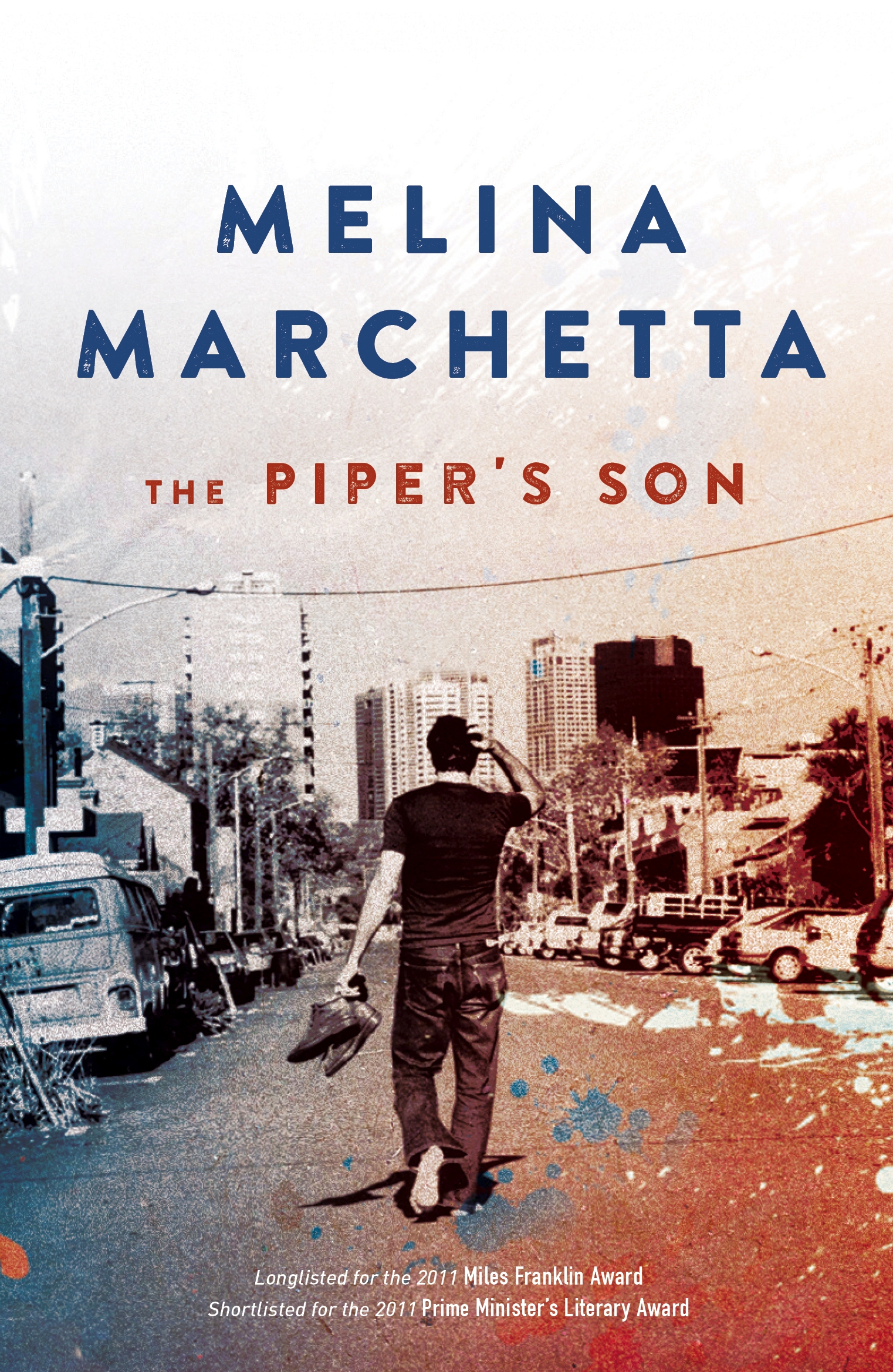
The Piper's Son
Author: Melina Marchetta
Q And A With Melina Marchetta
Q&A with MELINA MARCHETTA
Author of The Piper's Son, Viking, March 2010
When did you first know that Thomas Mackee (Saving Francesca)had his own story – and that it needed to be told? He was one of those characters who just popped up. After Saving Francesca I didn't plan a sequel. I never think that far in advance when I write, so it's a bonus when characters come calling again. I was planning to write a novel about a woman named Georgie Finch who had to travel to Europe to collect her brother's body. I never got further than that because I didn't know what to do with it. Over a year later I was watching an Australian Story about the Veterans who had returned to Vietnam to retrieve the bodies of the six servicemen left behind over forty years ago. I remember sitting there and Tom coming into my head and kind of telling me, ‘That's my family's story and Georgie Finch is my Aunt.' I was writing Finnikin of the Rock at the time, and having never had two stories in my head at once, I resisted. I didn't think Tom was big enough a character. But I couldn't get him out of my head and I realised that with this one I didn't have to go far from home to write it.
Describe the research behind The Piper's Son and why was this so important? Most of the research revolved around real events and how they impacted on the characters in the story. It's strange that you can spend so much time doing research and only a strand of it makes it into the novel. I interviewed Jim Bourke, for example, who was one of the Veterans who returned to Vietnam to retrieve the first two of the bodies left behind. It's where it all began for me, despite the fact that the return of my character, Lance Corporal Tom Finch, is only referred to a few times in the story.
With Joe Mackee's death (Tom's uncle) I rarely went into details. I didn't want the novel to be about terrorism or war. It's about loss and grief so I had to make sure I conveyed how his death impacted on the family. Reading the obituaries of those killed in the 2005 London bombings was the saddest research I've had to do. Georgie's profession was important as well. A friend of mine works for a branch of the Red Cross responsible for tracing people who have gone missing during wars and conflicts. A couple of years ago when they began to dig up the graves of those killed in the Balkans she interviewed the family and friends of those who were put on the bus at Srebrenica, asking questions about what they were wearing on the day they were last seen so the authorities could match them with bodies found in graves. I knew it was the worst profession to give a character who hadn't been able to bury her own dead.
Who was your favourite/most frustrating new character to write and why? Oh definitely Georgie. I love her to death. She seemed like the insignificant one, growing up in the shadow of her charismatic brothers, but she's actually the one who has to hold everything together when it falls apart. The other characters unconsciously do awful things to each other emotionally, but they get away with it more easily than Georgie. Ultimately though, it's Georgie who offers refuge to everyone in her home, even her estranged partner Sam and his little boy. I love that someone who isn't sweet and likeable, at times, can do that.
How did you approach the different generational voices for Tom and his aunt?
I had to let Tom hang out in my head for a while before I began writing. This was the case for Finnikin as well. I presume it's because both these characters are male and I don't understand men as much as I know women. I need to get under their skin, and I can't do that if I go straight into writing their story. By letting them hang out for a while, usually I get to understand their voice and their relationships.
I tried not to do too much when differentiating between Tom who's 21 and Georgie who's 42. Sometimes all I did was leave out personal pronouns with Tom in his point of view. ‘He doesn't speak. Can't.' I wanted Tom distanced from himself. He's a lost soul.
How did you decide which characters from your previous books would return?
I couldn't force any of them back because it's difficult to write characters that you have no idea what to do with, especially when it's not their story. Strangely, it was Tom's decision. I hoped that Francesca and Tara would return and they did. Those characters who didn't are still important to the story, even the very absent Jimmy Hailer, and Siobhan Sullivan who's in London, and Francesca's parents. I love Mia and Robert and every time I write a novel with Francesca they want to pop in and dominate. This time I had to send them overseas for a few months. But all their absences give a vulnerability to those left behind. It's what bonds Tom and Francesca and the others at the Union.
Describe how your own family, and their experience as migrants, has influenced your writing, and shaped the story behind The Piper's Son?
The only culture I really wanted to explore was the inner-west and inner city where I've mostly lived for the past fifteen years. The second generation in this novel, who are my age, come predominately from working class catholic backgrounds; they've ended up lapsed in their faith and have found themselves in the middle class, questioning who they are, and even arguing about the romantic idea of the working class.
I actually wanted this novel to be culturally non-specific. There was no way the Finch Mackees were going to be a stereotypical Irish catholic family. Both Tom's friendship group and that of his father's and Georgie's are quite similar in their racial mix, and very much like my own family. Apart from a word here or there in a different language I didn't chose to identify what their ethnic identity was. It's obvious that Francesca Spinelli has an Italian background, and that Abe and Lucia's kids are half Italian, half Lebanese, and that Ned the Cook is Anglo, and Mohsin the Ignorer is from Pakistan.
The book or movie that has most affected/inspired you and why?
The Royal Tenenbaums. I love stories of dysfunctional families where the children end up as adults under the one roof. And Wes Anderson is a genius on family relationships.
The soundtrack to accompany The Piper's Son would include…
Solsbury Hill by Peter Gabriel, How to Make Gravy by Paul Kelly, Samson by Regina Spektor, Your Ex-Lover is Dead by Stars, Smokers Outside the Hospital Door by Editors, Crazy Train by The Waifs, Union City Blues by Blondie, Like a Rolling Stone by Bob Dylan, The Blower's Daughter by Damien Rice and This Year's Love by David Gray.


News
{ view all }All That I Am by Anna Funder has won the Barbara Jefferis Award.
The award is offered annually for “the best novel written by an Australian author that depicts women and girls in a positive way or otherwise empowers the status of women and girls in society”.
Anna beat fellow Miles Franklin contenders Foal's Bread and Cold Light.
Social Feed
{ }Penguin TV
{ }Pictures
{ }