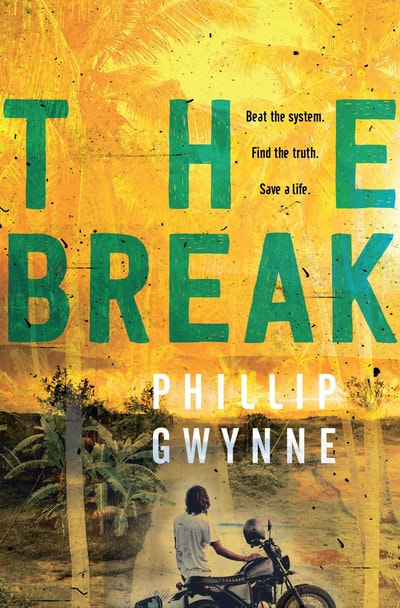
Swerve
Author: Phillip Gwynne
Extract
Sydney Conservatorium
'Such an opportunity,' says the Professor, for about the thousandth time, those eyebrows of his working overtime.
My father – in his suit – smiles at me. My mother – in her suit – smiles at me. Moreton, my sister, pokes out her tongue.
Both my parents have taken the morning off work. Both of them! Turned off their Blackberries. Both of them!
And neither of them has checked their watch once, even though we must have been sitting here in this high-ceilinged wood-panelled atrium for an hour already, waiting for me to be summoned by the Ancients.
On the walls are portraits of Bach, Beethoven,
Mozart, Wagner – the heavy-hitters. All of them seem to be echoing the Professor: solch eine Gelegenheit – such an opportunity.
You see, the Conservatorium never allows potential students to audition more than a week late.
Unprecedented, said the Professor. Such an opportunity, said the Professor.
It took a lot of doing: phone calls from Mum and Dad, from the headmaster at my school, the Professor using all his contacts, even a letter from Dr Jovanovich, the psychiatrist.
My phone rings!
Mum, Dad glare at me: they turned theirs off.
I go to do the same with mine when I notice who it is. Bella!
I can't help myself: I answer.
'Brockie, you've got to help me! Please, you've got to bail me out!'
That familiar voice does familiar things: a flurry of images, the thump of blood.
The heavy door creaks open, the head of an Ancient appears.
'Mr Twycross, the judges are ready now.'
'Brockie?' Bella implores.
I turn my phone off and stand up.
Dad smiles. Mum smiles. Even Moreton smiles. The Professor's eyebrows working overtime.
Such an opportunity.
Bach, Beethoven, Mozart, Wagner.
Solch eine Gelegenheit!
As I follow the Ancient into the auditorium I think of how this happened, how I got to be more than a week late for the most important audition of my life.
Sydney School
It was the last day of school and I was in the library watching the chess nerds play chess.
As usual, Zhang Zhong – or Zed Squared as we called him – opened with the Sicilian Defence. As usual, Sandipan Chandrasakan – or Randy Sandy Chandy as I wanted to call him – hit back with the Benko Gambit.
The extraordinary finish of last night's race replayed in my mind, causing me to get excited again, to unwisely open my mouth and say, 'You guys watch the Formula One?'
'Not cars again, Hugh,' complained Sandy, his finger on the knight.
'We're nerds,' stated Zed Squared, a sweep of his hand including me. 'And as such we don't enjoy car-racing.'
'In fact, we detest it,' said Sandy.
'Then obviously I'm not a nerd,' I said.
This provoked a squall of laughter, which in turn caused me to retreat to my favourite part of the library, to my favourite Dewey Decimal: 388.342, the car section. I took out my favourite book: Australian Muscle-Cars – The Definitive Guide.
Yes, I do exhibit characteristics normally associated with nerds: the whiteboy afro, for example; the fact that I play the cello, that I play chess; that I disdain sport, anything that privileges body over brain. And the fact that the girls aren't exactly firing off text messages suggesting that we meet after school for some adolescent experimentation of a sexual nature.
But because I exhibit characteristics normally associated with nerds, it doesn't mean that I'm a total nerd.
Not like Zed Squared or Randy Sandy Chandy are total nerds. I'm more like a ner or an erd.
Because weirdly, strangely, unfathomably, I love cars and I love car-racing.
Though perhaps the word 'love' is too puny to describe the way I feel about motor vehicles of the four-wheeled variety.
Certainly the Macquarie Dictionary's definition – 'a strong or passionate affection' – doesn't go close.
Shakespeare's 'love is merely a madness' is better, but a bit dismissive.
So maybe an example would be more illustrative.
Like last night.
There was no way my parents were going to let me stay up to watch the Formula One. There was no way I was going to ask them.
To use Randy Sandy Chandy's word, they detest car racing.
When I went to bed I'd convinced myself that it wasn't important. That it was only a race and I could log on first thing in the morning to get the result.
I couldn't sleep, though – my head was full of pit stops, chicanes and roaring Ferraris – and at two-twenty I got out of bed, crept down the hall and into the
TV room, watched the entire race in the dark with the sound down, and then crept back up the hall and back into bed just as the sun was coming up.
A strong or passionate affection?
Yeah, right.
Merely a madness?
Get real, Bill.
As I opened to page 24 of The Definitive Guide, to the first of the Holden muscle-cars, my mobile went off.
Mozart's Symphony in A Major.
I took it out, saw that it was 'Poppy Calling'.
That was a surprise: Poppy never rang me during school hours.
I answered.
'Quick! Put it on speakerphone!' he demanded.
Poppy's of the opinion that mobile phones and brains aren't a good mix. All that radiation, he says, has got to fry your noggin.
I held the phone away from my ear and the delicate organ that is my brain.
'How's school?' he asked.
'It's the last day of the year.'
'You can lay off the study for a while, then?'
'The audition is next Friday.'
'That's right. The Audition. How's your driving getting along?'
'It's difficult to get the hours up,' I said. 'Especially since the government's upped it to a hundred and twenty.'
My father's some sort of management consultant; he's always busy. My mother's some sort of management consultant too; she's always busy.
And even when there is an opportunity for me to drive, Mum seems to find some reason why I shouldn't.
You'd better not, Hugh, the traffic is hellish today. Or: It's hardly worth your while – we're only going a couple of suburbs away.
It's almost as if she doesn't want me to get my licence.
'Got a solution to that particular problem,' said Poppy.
He has this strange way of talking: every now and then he'll really emphasise a word, give each syllable its due. Par-tic-u-lar.
'Yes?'
'You can drive me to the big rock.'
'Which particular big rock would that be?'
'The Big Rock!'
'You mean Ayers Rock?'
'You got it – Uluru!' he said.
Poppy didn't have a licence; he didn't have a car; obviously it was one of his typically esoteric jokes.
'Sure,' I said, going along with it. 'When can we go?'
'How about five this afternoon?'
'I've got cello practice. The audition, remember?'
'Screw that!'
'You're right Poppy: screw cello practice, the audition and my future as a professional musician. We'll leave at five this afternoon for Uluru, the largest monolith in the world.'
'Alrighty,' said Poppy, and he hung up.
I rang him back immediately, but he didn't answer.
Maybe he wasn't joking after all, I thought. He's a pretty strange old dude.
Several times during the afternoon I tried his number. Same result.
I decided to drop in on him on my way to cello practice with the Professor even though it wasn't really on the way to cello practice with the Professor.
I lugged my cello to Town Hall station. Lugged it onto the train, the second carriage – I always take the second carriage – right into a flock of skanks.
It's what we – Sandy, Zed and me – call girls like this.
The skanks go to the nearby TAFE-run high school. They don't wear uniforms, they've got piercings, they've got tattoos, their hair is dyed all sorts of ridiculous colours.
'Hey, Grammar boy,' squawked one of them.
I gave her what I hoped was a superior stare and attempted to hide behind my cello.
'What you got in the case, cute Grammar boy? Money?'
This joke – if you could call it that – set the rest of the skanks off.
More skanky squawking.
It was a relief when the train reached Kings Cross.
There was the usual scum on the street: prostitutes and their pimps, drug dealers and their druggies.
I'm not sure why Poppy – why any decent person – would want to live in an open sewer like Kings Cross.
Like many things about him, it was a mystery, a puzzle. Yes, he's my grandfather, my mother's father, but six months ago I hadn't even known that he existed.
Then a skinny old guy with a long silver ponytail and a hippie waistcoat turned up at the school gate one afternoon.
He looked like a mad scientist or the leader of some weird cult, one of those men who could persuade people to hand over their house, their life savings and the virginity of their fifteen-year-old daughter.
'Hugh,' he said, as I walked past, looking at me with mad scientist eyes.
'Yes?' I said, wondering how he knew my name.
'I want to talk to you.'
Stranger danger! Stranger danger! Sandy and Zed Squared sped up, demonstrating a very un-nerd-like turn of pace.
There was something about him, beyond the ponytail and the hippie waistcoat, that was familiar, that made me stop and say, 'About what?'
'About you and me.'
Mad eyes glowing again and I was on the move, catching up to Sandy and Zed Squared. Stranger danger! Stranger danger!
His voice followed me. 'Your name is Hugh Twycross. You were born on the seventeenth of February in nineteen ninety-three. Your mother's name is Carol Jennifer Hughes. She was born on the twenty-third of May in nineteen fifty-eight.'
I stopped, calling back to him: 'How do you know all this stuff?'
'Because I'm your grandfather.'
'No, you're not!'
Pop, my dad's father, lived with Nan in Coffs Harbour and played golf. Grandpa, my mother's father, lived with Grandma in Mosman, and played golf.
'Your mother is my daughter,' he said.
Technically this was possible – Grandpa was actually my mother's stepfather – but there was one small problem.
Which I relayed to him.
'My mum's real father is dead!'
And had been since before I was born.
'Then you're looking at a ghost, kiddo,' he said.
Again, I had that feeling of familiarity. This time, however, I realised why: the skinny old guy had my mother's nose, my mother's chin. My nose, my chin.
I let him catch up to me. Let him talk to me.
That night I told Mum that her father had come to the school.
'My father is dead,' she said.
'But he knows all this stuff about us.'
'My father is dead,' she kept repeating, but she was getting flustered, more flustered than I'd ever seen her.
'He showed me a copy of your birth certificate,' I said.
Eventually, she conceded: 'My father is dead to me.'
And that was as far as it went, explanation-wise.
I rang Grandma.
'It's best your mother explains,' was all she could manage.
Mum insisted that I was to have nothing at all to do with him, of course.
She contacted the school: if he was outside the school grounds there was nothing they could do. She contacted the police: if he wasn't threatening me in any way there wasn't anything they could do, either.
When he turned up at school the next day in the same hippie waistcoat I walked right past him; if he was dead to Mum, he was dead to me.
Same the day after.
But on the third day I stopped.
Again, it was that familiarity: looking at him was like looking into some weird warped mirror.
As I did, a Torana – page 57 of The Definitive Guide – pulled up at the lights, orange with black trim, exhaust percolating. I couldn't help but say, 'Wow!'
'You know what it is?' asked the old man.
'Of course. It's a Torana LC GTR XU-1.'
'Actually, it's the LJ.'
Instantly, I knew he was right. Embarrassed, ashamed,
I blurted, 'Peter Brock won the 1972 Hardie-Ferodo 500 in it.'
'By five laps.'
'How do you know that?'
'I was there.'
'So you're . . .' I hesitated – this wasn't a question you asked lightly. 'You're Holden?'
He looked insulted.
'My grandfather was a Holden man. My father was a Holden man. Of course, I'm Holden.'
The lights changed and the Torana took off, flashing through the traffic, through the sludge of Corollas and Camrys.
'I'm Holden, too,' I said.
This wasn't just a statement, it was an admission, a confession, the most thrilling three words I'd ever uttered in public.
'Of course you are, son,' said the old man, said my grandfather. 'Of course you bloody well are.'
After that, I saw him often. I told Moreton but nobody else. Especially not Mum or Dad. Especially not Mum.
When I arrived at Poppy's building, the same druggie with the rotting teeth was lounging outside.
'You got some change for a cup of coffee?' he asked.
'No!' I snapped, outraged – I'd never given him money before, why would I start now?
And if he was going to beg for a living he should do a better job of it, learn to recognise his non-customers.
We had this speaker at our school. Drug addiction is a sickness, she told us. A disease. Nonsense! I was in total agreement with Mum and Dad on this: drug addiction is a weakness, the worst sort of weakness there is.
I climbed up the steps, knocked on the door and Poppy's voice came from inside, growling, 'Enter!'
Down the corridor I walked, past paperbacks piled on top of each other, weird paintings on the walls, all the stuff he'd collected during those years he'd lived overseas.
He was sitting straight-backed at the kitchen table, a road map of Australia spread out in front of him. Silvery hair in a ponytail.
In this light the taut skin of his face had a yellow tinge.
'We're here,' he said, jabbing a finger at Sydney.
He was like that, Poppy. No 'hello', no 'how are you?' Just straight into what matters, the nuts and bolts.
'And Uluru is here,' he said, pointing to the centre of Australia. 'Two thousand and eight hundred ks away.'
He turned to look at me.
'It's a fair bloody hike.'
I agreed. 'A fair bloody hike.'
'So you up for it?'
I looked closely at Poppy's face – he didn't appear to be joking.
'You really serious about this?'
'Never been more serious in my life.'
'But why?'
'Because I always wanted to go there and I figure now's the time to do it.'
'And you want me to drive you there?'
'Well, I can't, can I?'
'I'm a Learner, Poppy. I can only drive when there's a supervising driver who has a current licence.'
'You're looking at him.'
'You've got a licence?'
He took out a leather wallet from his pocket, opened it, extracted a plastic card and placed it on the table.
A New South Wales driving licence.
'You don't drive, but you've got a licence?'
Poppy shrugged. 'No big deal.'
'I've got the audition next Friday.'
'We'll be back in time for that.'
I did the maths in my head: two times 2800 was 5600 ks. At 80 ks an hour, the maximum speed I was permitted, that was seventy hours of driving. Seventy hours!
Then I thought of the audition. The Conservatorium. My parents.
'Obviously, I can't go.'
'I respect that, it's your decision,' he said, folding the map up. 'But I'd just like to show you something.'
My cello and I followed Poppy out of the flat and back onto the street.
The druggie with the rotting teeth was still there, still begging.
'You got some change for a cup of coffee?'
Poppy dug into his pocket, brought out some coins, poured them into his hand.
'There you go, brother,' he said.
'Aren't you just encouraging them?' I asked after we'd moved down the street a bit.
'Them?'
'Yeah, them.'
Poppy seemed about to say something, but held back. 'Probably.'
I followed him as he turned into of the many back alleys in this area, keeping an eye out for dog shit, potential muggers and discarded syringes.
He stopped in front of an old-fashioned-looking garage with double wooden doors and a hefty padlock.
He took out his keys, undid the padlock.
'You ready?' he said, looking back at me.
I nodded.
He took a door in each hand and swung them open hard.
It'd been a big build-up and I was primed for an anticlimax: crates of dusty Elvis records, a not-so-complete set of Encyclopaedia Britannica.
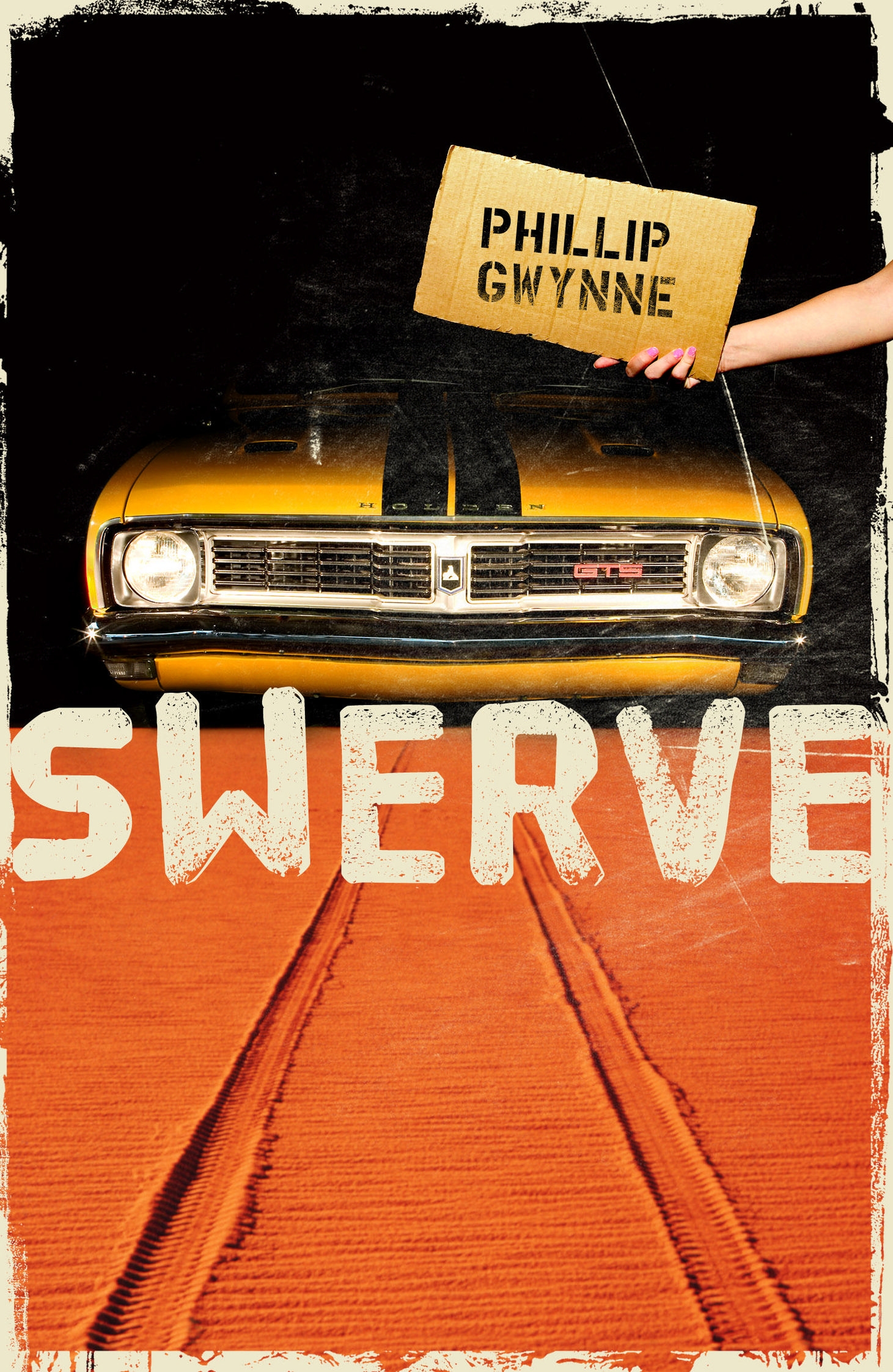
Instead, spot-lit by two shafts of light from the highset side windows, there was a car, but not just any car, perhaps the ultimate muscle-car, page 42 of The Definitive Guide, a 1969 Holden HT Monaro GTS 350 V8.
I hadn't seen one in the flesh before, and when I say flesh, I mean flesh.
Yellow with black stripes, it looked like a tiger out of its cage.
It looked magnificent. It looked carnivorous. It looked ready to roar.
It was a while before I could speak, before I could ask, 'Whose is this?'
Poppy had a look on his face and though I'd only met him six months ago I knew him well enough to know what it meant.
It was his.
His 1969 Holden HT Monaro GTS 350 V8.
'Why didn't you tell me you owned one of these?'
Poppy answered with a smile and a question of his own. 'You up for it?'
'Drive you to Uluru?'
Poppy nodded.
I thought of the audition. The Conservatorium. My parents.
I thought of driving 2700 ks to Uluru in a Holden HT Monaro GTS 350 V8.
Seventy hours in my logbook.
Then I stopped thinking.
Even so, I couldn't quite believe the words that came out of my mouth: 'I'm up for it.'
'Alrighty,' said Poppy. 'We'll drop into your joint and pick up your stuff.'
I always carried plastic 'L' plates in my school bag, just in case Mum or Dad picked me up at school. In case Mum actually let me drive.
I jammed one under each of the numberplates.
I also carried my logbook for the same reason.
I stuck it in the glove box.
I got comfortable in the driver's seat.
Inside it smelt like no other car I'd been in: musty – Poppy said it hadn't been used in a while – but a mixture of other smells, too. There was the smell of old leather, there was the smell of raw fuel and, though I'm no expert, there was definitely the smell of sex.
I adjusted the rear-view mirror, the outside mirrors.
Poppy said nothing – unusual for an adult, as they all seem to think they have something to offer the Learner driver. Even those who don't drive think they have something to offer the Learner driver.
Poppy handed me the key.
'There's a spare one under your seat,' he said.
I inserted the key and twisted the ignition: the starter motor whirred and the mighty V8 cleared its throat and cleared its throat and cleared its throat.
'Probably need to give it a bit of choke,' said Poppy eventually.
I knew about 'chokes' – they literally choke off the air from the carburettor to make the fuel mix richer – but I hadn't driven a car that had one, not a manual one.
Poppy pointed to a knob on the dash. 'Pull that sucker out.'
I did as he suggested, turned the ignition again. This time the motor started, the entire car rumbling.
I went to put it into gear.
'You might want to let it warm up a bit.'
Again, I did as Poppy suggested, sat there while the motor ran. It was like an orchestra tuning up, the discordant sounds getting smoother, becoming music.
'I'd say we're ready to rock'n'roll,' said Poppy.
I found reverse and released the clutch.
The muscle-car stalled.
I restarted the engine and tried again. Again it stalled.
And again. Same result.
Each time my embarrassment doubled: we weren't even going to get out of the garage, let alone to Uluru.
I could hear all the people on the street – the pimps, the prostitutes, the drug dealers, the druggies – sniggering at the private schoolboy.
The next time it stalled I looked across at Poppy.
'I can't do this.'
'No rush,' he said.
'But I can't do it.'
'No rush,' he repeated.
'You're supposed to give me advice.'
'I just did – no rush.'
'What sort of advice is that?'
Poppy shrugged. 'It's all I've got.'
I adjusted the seat, moving it closer to the front. I put the gears into neutral and pumped the clutch, getting more of a feel for it.
When I felt ready I tried again. This time the Monaro bunny-hopped out of the garage and I swung it into the lane.
'You want to close the garage?' I asked Poppy.
'Don't worry about it,' he said.
I changed into first and we were away.
Poppy smiled at me.
'No rush?' I asked.
'No rush.'
When we stopped at the lights, Poppy said, 'You know what, let's go right here.'
'But my place is left.'
'We need to get a move on, otherwise we'll be caught in peak hour.'
'What about my clothes?' I said, tugging at my school tie.
'We'll buy you some stuff on the way.'
'And that?' I said, pointing to the cello case on the back seat.
'He can come along for the ride.'
'I'm not sure . . .'
'Let's get this sorted up-front, kiddo. You're the pilot but I'm the navigator. You got that?'
The lights went green, the late-model Audi behind us beeped.
I had this feeling that I was making a horrendous mistake and now was the time to pull out.
The audition, the Conservatorium, my parents, my future, all telling me to turn left, to go home.
Again the Audi behind beeped, more insistently.
I released the clutch, pressed on the accelerator. This time there was no bunny-hopping and the Monaro moved smoothly off.
I breathed in deeply. Old leather, raw fuel, and, though I'm no expert, definitely sex.
As I turned right the Audi roared past, the driver – suit, sunglasses – giving us the finger out the window.
'Welcome to the jungle,' said Poppy.


News
{ view all }All That I Am by Anna Funder has won the Barbara Jefferis Award.
The award is offered annually for “the best novel written by an Australian author that depicts women and girls in a positive way or otherwise empowers the status of women and girls in society”.
Anna beat fellow Miles Franklin contenders Foal's Bread and Cold Light.
Social Feed
{ }Penguin TV
{ }Pictures
{ }